
The conversion rate formula is a crucial tool or element for any business. It indicates the percentage of users within their potential audience who complete a specific action—such as clicking an ad, installing an app, making a purchase, and so forth.
Table of Contents
What is conversion rate formula
Conversation rate is a marketing metric that calculates the percentage of customers who convert into desired action through ads or content in businesses’ websites, apps, or other digital formats. At the same time, it is used as a key performance indicator (KPI) which tracks marketing campaigns and website performance.
The formula to calculate the conversion rate is:
Conversion Rate formula = (Number of Conversions / Total Number of Website Visitors) x 100
Important of conversion rate formula
The conversion rate formula is a crucial and valuable metric for measuring business success, providing a clear picture of a brand’s marketing efforts. Furthermore, it plays a vital role in business operations—such as aiding in the measurement of ROI (Return on Investment)—by helping to convert traffic into customers. Additionally, it strengthens decision-making, enabling the optimization of campaigns, advertisements, or landing pages to enhance overall performance.
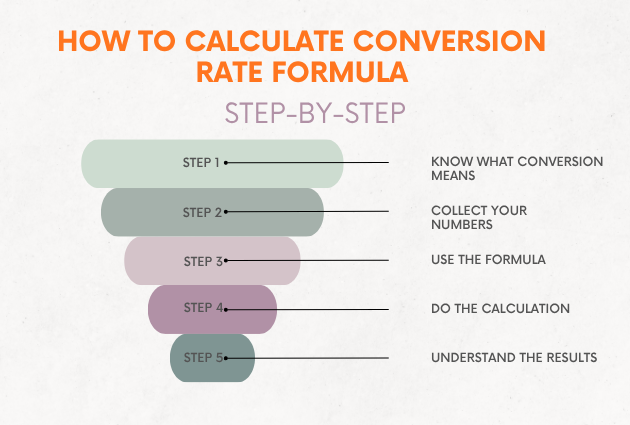
how to calculate conversion rate formula step by step
🎯 Step 1: Know What Conversion Means – To calculate the conversion rate, one must have a clear understanding of the basics—specifically, that the true meaning of “conversion” lies in guiding audience members, users, or visitors to complete a desired action for the business. Different businesses have different desired actions—such as increasing sales, improving customer engagement, or capturing leads, among others. All of these activities directly impact revenue, growth, and customer relationships.
📊 Step 2: Collect Your Numbers – Accurate data collection is crucial when calculating conversion rates, as it provides a business with a clear insight into its actual performance. To gather these metrics, businesses focus on audience activity and performance; this enables them to identify and refine strong campaigns and strategies, while accurate data facilitates better decision-making and smarter execution of plans.
🧮 Step 3: Use the Formula – The conversion rate formula is highly useful for expressing marketing performance in percentage form, providing businesses with clear and measurable results. Businesses utilize this tool to make their decision-making processes easier, more accurate, and faster. Overall, the application of this formula not only enhances the effectiveness of marketing strategies but also directly improves engagement.
🔢 Step 4: Do the Calculation – This constitutes a crucial step in conversion rate calculation, the primary objective of which is to transform raw numbers into actionable business insights. Furthermore, it involves tracking the effectiveness of audience responses relative to business goals, thereby enabling the business to devise strategies and implement campaign improvements aimed at strengthening audience engagement.
🚀 Step 5: Understand the Results – In the final step of conversion rate formula, a business properly analyzes its results by evaluating its marketing efforts to measure the value generated. This process reveals the extent of customer engagement with—and interest in—the brand. This enables a deeper analysis of audience behavior and campaign performance in the future, allowing for the optimization of underperforming campaigns; furthermore, understanding these results can significantly enhance future planning.
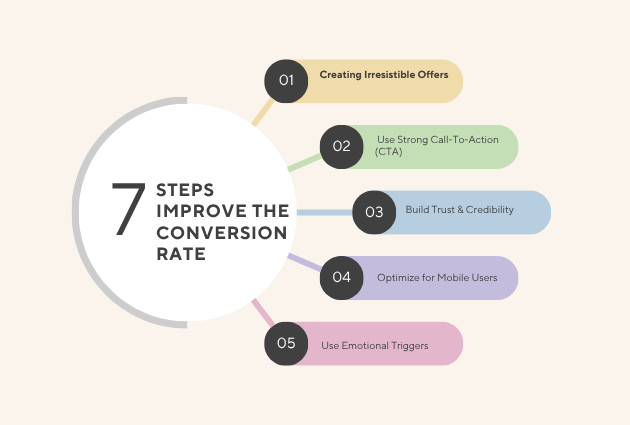
How to improve the conversion rate
1. Know Your Audience Deeply – To improve your conversion rate, deeply understanding your audience is a crucial step in making your marketing efforts effective; this enables you to provide your audience with valuable products, content, and offers tailored to their specific needs, problems, interests, and buying behaviors. Social media—through comments, polls, and reviews—along with website analytics, provides useful insights that not only boost conversion rates but also foster emotional connections that drive conversions.
2. Creating Irresistible Offers – Creating attractive and irresistible offers is a powerful strategy for improving conversion rates, wherein brands provide extra benefits and valuable incentives—such as discounts, free trials, combo deals, cashback, and bonus gifts—to capture customer attention, thereby automatically strengthening their buying intent. Furthermore, offers such as “Free Delivery,” “30-Day Money-Back Guarantee,” or “Buy One, Get One Free” serve to build trust and confidence.
3. Use Strong Call-To-Action (CTA) – A strong Call-To-Action (CTA) plays a crucial role in improving conversion rates by—simply put—guiding and motivating the audience to take the next step. These CTAs typically take forms such as “Get Started,” “Buy Now,” “Sign Up Today,” or “Download Free.” The primary advantage of a CTA is that it simultaneously evokes both emotion and a sense of urgency, which proves highly effective in prompting customers to take immediate action.
4. Build Trust & Credibility – Building trust and credibility is an effective and robust strategy essential for improving conversion rates. The process of establishing brand trust involves demonstrating transparency and honesty—specifically by providing customers with clear and valuable information, thoroughly explaining product details, and explicitly disclosing any hidden charges. These activities significantly boost a brand’s trust and credibility, while customer reviews, testimonials, and ratings instill a sense of confidence in the customer.
5. Optimize for Mobile Users – In the digital world, the majority of people are mobile users; therefore, mobile optimization plays a crucial role in significantly increasing conversion rates. The optimization process involves perfectly adjusting elements such as design, speed, buttons, images, and text to make a website or landing page mobile-friendly, thereby ensuring a smoother and superior user experience. Furthermore, clear buttons and fast loading speeds serve to boost the conversion rate.
6. Use Emotional Triggers – The use of emotional triggers also proves highly effective in boosting conversion rates. Its primary objective is to strongly influence customer buying behavior by evoking excitement, urgency, trust, or desire in their minds—through phrases such as “Limited Time Offer,” “Only a Few Items Left,” or “Join Thousands of Happy Customers.” Furthermore, by showcasing real-life problems and relatable situations through brand storytelling, a powerful and lasting impression of the brand is established in the customer’s mind.
7. Test & Improve (A/B Testing) – Conducting A/B testing is a smart and powerful strategic move; by continuously testing and refining elements such as brand headlines, button colors, images, offers, landing pages, email subject lines, or Calls-To-Action (CTAs), businesses can generate maximum clicks and conversions—for even small changes can sometimes yield a massive impact. A/B testing demands patience and consistency, enabling businesses to continuously learn and improve.
Example of Conversion Rate Formula
Four mathematical examples illustrating the conversion rate formula have been provided to make it easier for you to understand.
Example 1: Website Sales
Suppose a website received 3,000 visitors in one week, and out of those, 250 visitors completed a specific action.
To calculate this:
We use the formula: Conversion Rate = (Total Conversions / Total Visitors) × 100.
Total Visitors = 3,000
Total Conversions = 250
Conversion Rate = (250 ÷ 3,000) × 100
= 8.33%
This percentage signifies that, out of every 100 visitors, approximately 8 were converted into customers. This gives companies insight into how to improve their marketing strategies.
Example 2: Lead Generation
The primary objective of lead generation is to transform an interested audience into potential customers. To achieve this, brands run online advertisements. Suppose 15,000 users visited the landing page associated with such an advertisement, and 1,800 of them clicked through. Let’s calculate the conversion rate:
Total Users = 15,000
Total Clicks = 1,800
Conversion Rate = (Total Clicks / Total Users) × 100
Conversion Rate = (1,800 / 15,000) × 100
= 12%
Based on this calculation, the conclusion is that out of every 100 users, 12 completed the specific action desired by the brand.
Example 3: Email Marketing
An email marketing campaign is an effective method for engaging an audience. For instance, if a business sends 14,000 emails as part of a campaign, and 1,200 users subsequently complete a desired action, the conversion rate can be calculated using the following formula:
Conversion Rate = (Successful Actions / Total Emails Sent) × 100
= (1,200 / 14,000) × 100
= 8.57%
Based on these results, approximately 9 users took action for every 100 emails sent.
Example 4: Social Media Ads
Social media is an online platform that includes applications such as WhatsApp, Facebook, LinkedIn, and Instagram. Brands utilize this medium to run advertisements. These ads reached 18,000 users, of whom 1,500 converted to customers. Let’s calculate this using the following formula:
Conversion Rate = (Customers Converted from Ads / Total Ad Viewers) × 100
= (1,500 / 18,000) × 100
= 8.33%
Therefore, mathematically speaking, running these advertisements resulted in 8 out of every 100 users converting into customers.
The final words
In the era of digital technology, the conversion rate formula serves as a useful tool for measuring business progress. It also facilitates the understanding of ROI, the optimization of campaigns, and the analysis of audience behavior.
This article on the conversion rate formula provides an in-depth analysis covering its definition, various formulas, mathematical examples, common pitfalls to avoid, the relationship between CTR and CVR, step-by-step calculation methods, and diverse strategies for improving conversion rates.
Furthermore, it highlights various tools and metrics that will prove instrumental in measuring business growth.
Frequently Asked Questions (Conversion Rate Formula)
Types of conversation rates
There are many variations of the conversion rate formula, but each possesses a unique characteristic that is utilized to complete different tasks.
- Landing Page Conversion Rate
- Click-Through Conversion Rate (CTR)
- Lead Conversion Rate
- Email Conversion Rate
- Sales Conversion Rate
- Call Conversion Rate
- Cart Conversion Rate
- App Download Conversion Rate
- Social Media Conversion Rate
- Signup Conversion Rate
- Video Conversion Rate
- Free Trial Conversion Rate
- Subscriber Conversion Rate
What is CTR and CVR?
CTR => The full form of CTR is Click-Through Rate. Its primary objective is to demonstrate the attractiveness of a brand’s advertisements and the level of audience interest—specifically, their ability to attract people. Headlines, images, and high-quality content are the key elements for generating a high CTR, which is typically expressed as a percentage.
The formula for this is: CTR = (Total Clicks / Total Impressions) × 100.
CVR => CVR stands for Conversion Rate. Its primary objective is to measure how many users or members of the audience have fulfilled a brand’s desired actions—such as filling out a form, purchasing a product, or subscribing—thereby enabling the assessment of business growth. Its formula is:
CVR = (Total Conversions / Total Visitors or Clicks) × 100
What is a good conversation rate in sales
A robust conversion rate serves as a crucial metric for measuring business growth. It reflects the process of transforming visitors, leads, or interested individuals into paying customers. To achieve a favorable conversion rate, businesses must conduct an in-depth analysis of their customers’ needs, emotions, and purchasing behaviors, enabling them to craft tailored offers; this naturally boosts the conversion rate while simultaneously providing a significant uplift to sales.
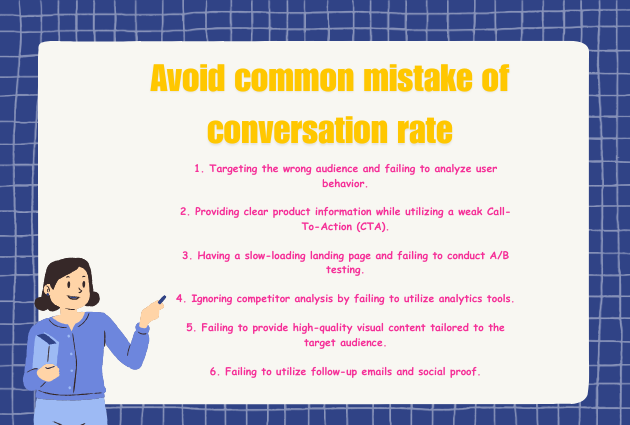
Avoid common mistake of conversation rate formula
Important and common mistakes regarding the conversion rate formula that every business should avoid to minimize the challenges they face in the future.
1. Targeting the wrong audience and failing to analyze user behavior.
2. Providing clear product information while utilizing a weak Call-To-Action (CTA).
3. Having a slow-loading landing page and failing to conduct A/B testing.
4. Ignoring competitor analysis by failing to utilize analytics tools.
5. Failing to provide high-quality visual content tailored to the target audience.
6. Failing to utilize follow-up emails and social proof.
Important matrix and tools of conversation rate formula
Tools:-
Hotjar & Crazy Egg – Primarily used for landing page optimization.
Google Analytics – Used for tracking user behavior, traffic sources, audience activity, and conversions.
Mailchimp & HubSpot – Used to track email conversions, thereby improving personalized marketing.
Semrush – A keyword research tool that helps improve search engine rankings.
VWO & Optimizely – Used for A/B testing to identify the best-performing version.
Matrices=> Bounce Rate,Click Through RateCustomer Acquisition Cost,Average Session Duration,Pages Per Visit, conversation rate,Customer Lifetime Value,Return on Investment,Lead Conversion Rate etc