
Promotion serves as an effective means for marketers to convey information about products and services to their target audience. It constitutes a crucial aspect of marketing strategies, as it enhances brand awareness, visibility, and sales.
Through promotion, marketers educate both potential and existing customers regarding the value of a product, thereby strengthening their buying intent and converting that intent into concrete action.
A promotion strategies is a marketing tool utilized to facilitate communication between sellers and buyers.
Let’s explore this further.
Table of Contents
What is promotion strategies with example
A promotion strategy is a proven technique that introduces products and services to the market, thereby accelerating the growth of their demand. This enables you to reach your potential customers effectively, generate maximum awareness, and ultimately persuade them to purchase your products.
By executing your plans effectively, you can strengthen your brand’s positioning in the market; furthermore, by combining multiple business strategies, you can ensure your long-term growth.
Examples of such strategies include paid advertisements, limited-time discounts, email marketing, social media marketing, and others.
Importance of promotion strategies in business
Promotion strategies are considered a crucial component of any business, as they play a pivotal role in driving business growth. A well-devised strategy offers multifaceted benefits to businesses—such as enhancing brand awareness, attracting and engaging customers, boosting sales and revenue, and staying ahead of the competition.
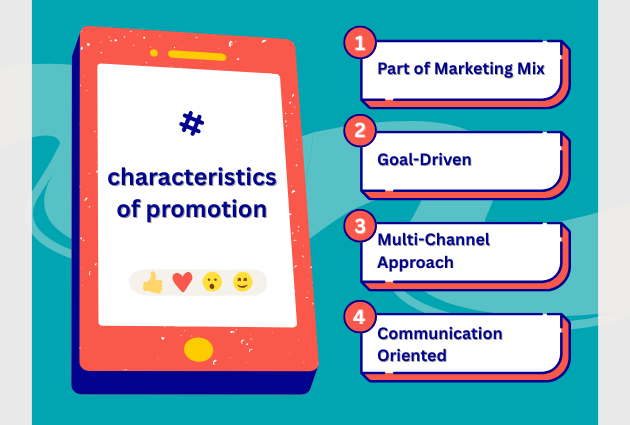
seven key characteristics of promotion
Part of Marketing Mix _ The marketing mix constitutes an essential component of key characteristics, comprising seven elements that generate awareness by providing valuable information about a product or service, thereby facilitating the natural conversion of customers into buyers. Among these elements, Product, Price, Place, and Promotion serve as the four primary pillars, while People, Process, and Physical Evidence are particularly relevant for service-oriented businesses.
Persuasive nature _ A persuasive nature is an essential characteristic of promotion, the primary focus of which is to influence customers and strengthen their buying intent, thereby encouraging them to purchase products or services. Brands that target customers’ needs, desires, and emotions—designing their products specifically to address those problems—effectively highlight their unique value proposition to create a strong and lasting impression in the minds of their customers.
Goal-Driven _ A goal-driven approach renders promotion both effective and result-oriented, necessitating not only meticulous planning but also rigorous evaluation. This goal-driven strategy ensures that promotional objectives—such as setting specific targets—are aligned with the product’s positioning, pricing strategy, and distribution plan. The aim is to heighten brand awareness, stimulate demand, and drive a continuous increase in sales, thereby significantly enhancing the brand’s overall image.
Communication-Oriented _ A communication-oriented approach serves as an effective method for strengthening the understanding and connection between a brand and its customers, thereby establishing a robust communication link. This is because simple and clear communication enables customers to perceive the product more effectively, while simultaneously conveying vital information regarding key elements such as the product’s value, price, quality, and availability.
Paid & Non-Paid Methods _ Paid and non-paid strategies constitute a powerful methodology that renders promotional efforts both diverse and impactful. While paid promotional activities require financial investment, non-paid promotions spread naturally or indirectly. The combined synergy of these two approaches enhances brand awareness and reach, while simultaneously influencing various types of audiences.
Multi-Channel Approach _ The multi-channel approach is a crucial strategy through which a brand leverages various platforms and channels to reach a wider audience, thereby enhancing visibility and awareness. Furthermore, through continuous communication, it cultivates strong brand recall in the minds of customers—a process that is both engaging and impactful.
Target Audience Focused _ Target Audience Focus is a specialized strategy wherein customers are segmented into specific groups based on their needs, preferences, age group, income level, and behavior. This approach aims to make promotional efforts more effective and meaningful, while simultaneously leveraging personalization to make customers feel valued—thereby boosting both engagement and interest.
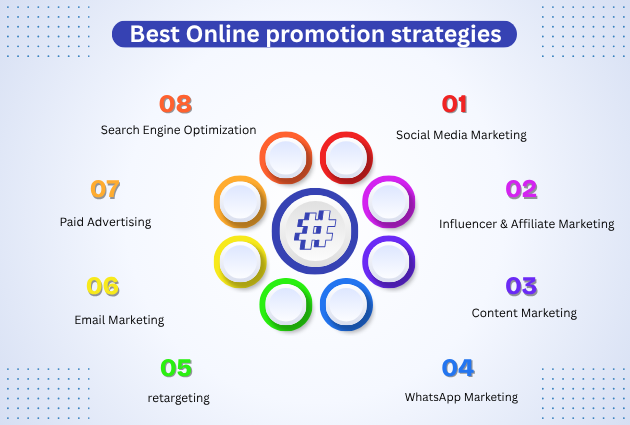
Best Online promotion strategies
🚀 1. Social Media Marketing – Social Media Marketing is a powerful promotion strategies utilized to promote products or services and to cultivate strong, direct relationships and trust with an audience. Consistency plays a pivotal role in this process, as it requires continuously providing the audience with valuable and engaging content; furthermore, creating content tailored to the audience’s interests automatically leads to an increase in reach.
🔍 2. Search Engine Optimization (SEO) – Search Engine Optimization (SEO) is also an essential component of online promotion strategies. It involves posting useful and valuable content—aligned with the algorithms of search engines like Google and Yahoo—using appropriate Title Tags, Meta Descriptions, and Heading Tags, in order to help a brand’s website and content rank at the top of search results and thereby generate maximum clicks and leads.
💰 3. Paid Advertising (PPC) – Paid Advertising (PPC) is a powerful online promotion strategies for generating quick results. Its primary benefit is that payment is required only when an ad receives a click. From a targeting perspective, you can target audiences based on their location, age, interests, and behavior, thereby increasing the chances of conversion. The creativity of the ads also plays a crucial role, making it essential to maintain a balance between the content, headlines, and visuals.
📧 4. Email Marketing – Email marketing is a digital promotion method that allows you to easily reach the inboxes of your target audience and build strong relationships. Email is primarily used to share valuable information, facilitate personal communication, and promote products. Overall, email marketing is a cost-effective strategy that plays a pivotal role in fostering long-term relationships with the audience and driving business growth.
🤝 5. Influencer & Affiliate Marketing – Influencer and affiliate marketing are modern-day online promotion strategies in which brands leverage the reach and credibility of influencers and affiliates to promote their products and services, paying them a commission or a fixed fee in return. Since these individuals possess a loyal audience—and because people tend to trust genuine recommendations more than traditional advertisements—this approach results in higher conversion rates.
🧠 6. Content Marketing – Content marketing is an effective online promotion strategies that enables you to attract and engage a maximum audience through valuable content. This content encompasses elements that are informative, knowledgeable, and entertaining, among others. In this approach, identifying the audience’s needs and problems—and addressing them through compelling storytelling—leads to increased traffic and engagement, which subsequently translates into conversions and brand loyalty over time.
📱 7. WhatsApp Marketing – WhatsApp Marketing serves as one of the best online promotion strategies for small businesses and startups. Its primary advantage lies in the fact that, since messages are delivered instantly, the likelihood of them being opened is significantly high. The main objective is to facilitate rapid and responsive real-time interactions, thereby allowing users to experience a personal touch and ensuring that the communication feels both natural and valuable.
How its works: Step-by-Step Approach in Business
**Know Your Target Audience** – To achieve maximum results from your promotion strategies, it is essential to identify and select your target audience. By understanding their age, gender, location, income level, interests, and lifestyle, you can effectively address their specific problems and needs. This approach helps build trust, thereby significantly increasing the chances of conversion.
**Create a Unique Offer** – To achieve rapid growth through your promotion strategies, leverage unique offers. Incentives such as discounts, cashback, free delivery, combo packs, “Buy One, Get One Free” deals, free trials, or limited-time offers can instantly attract customers. Furthermore, offering something unique helps differentiate you from your competitors.
**Pick the Best Promotion Channel** – Choosing the right promotional channel is a crucial component of any effective strategy, as different platforms cater to distinct audiences. For instance, LinkedIn, email marketing, and Google Ads are highly effective for reaching professionals, while Instagram, Facebook, YouTube, and WhatsApp serve as the best options for targeting a younger demographic.
**Launch with Eye-Catching Content** – Creating eye-catching content is indispensable in promotional strategies. By utilizing catchy headlines, attractive images, creative videos, vibrant designs, and powerful messaging, you can make your content appealing, clear, and engaging. This helps capture the audience’s attention and motivates them to take the next step, thereby improving conversion rates.
**Track Results & Improve** – In the final stage, continuously tracking your campaign’s results and making ongoing improvements is essential for ensuring the strategy’s success. This tracking involves monitoring key metrics such as sales, leads, engagement, and website traffic. Tools such as Google Analytics, Facebook Insights, Instagram Insights, CRM systems, and ad reports are utilized to analyze performance data and optimize the campaign accordingly.
Advantages and disadvantages in the form of table comparison
| Advantages | Disadvantages |
| boosts sales by increasing brand awareness. | Its impact is short-term. |
| keeps you ahead of your competitors. | It is a time-consuming process. |
| Strengthen brand image by improving customer loyalty. | Incorrect targeting does not yield measurable results. |
| delivers quick results with ease. | The ROI is not fixed. |
| enables you to reach new and a wider base of customers. | Over-promotion can diminish brand value. |
Frequently Asked Questions
Core Types of Promotion
Promotion takes many different forms; here, a selection of the most important ones have been listed, such as Advertising, Sales Promotion, Personal Selling, Public Relations (PR), Direct Marketing, Digital Marketing Promotion, Referral Marketing, Trade Promotions, and Event Marketing, among others.
Best Promotion ideas
While there are numerous ideas for promotion, it is the proper execution of those ideas that actually drives business growth. Some key ideas that truly work are listed below.
🎁 Limited-Time Discount Offer
🔥 Buy 1 Get 1 Free
📱 Social Media Giveaway
🤝 Referral Program
⭐ Influencer Promotion
💥Flash Sale
📧 Email Marketing Offer
🎯 Free Sample / Trial
🛍️ Bundle Offers
🏆 Contest Campaign
🌍 Local Event Sponsorship
🎈Festival Special Promotion
🔥 Loyalty Program
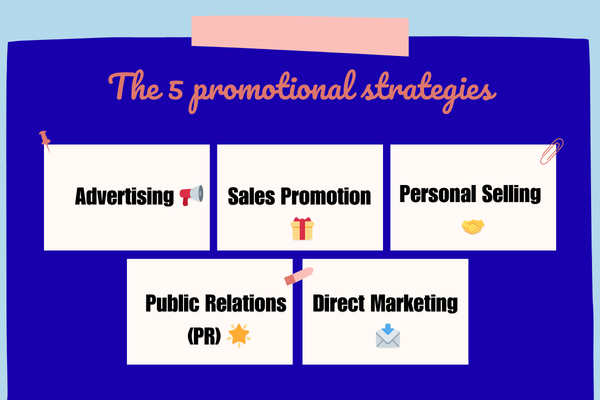
What are the 5 promotional strategies
1. Advertising 📢: Advertising is a paid promotional method through which you promote products or services via TV, radio, newspapers, magazines, billboards, social media, and Google Ads. To make it even more effective, catchy headlines, attractive designs, clear messaging, and strong calls to action are incorporated.
2. Sales Promotion 🎁: Sales Promotion is a short-term marketing strategy designed to generate an immediate increase in sales through various incentives such as discount offers, coupon codes, cashback deals, free gifts, “Buy One, Get One Free” (BOGO) offers, and festive promotions.
3. Personal Selling 🤝: Personal Selling is an effective method for boosting sales, utilizing face-to-face meetings, phone calls, video calls, or one-on-one communication to strengthen personal connections. This approach fosters trust and creates a positive impression.
4. Public Relations (PR) 🌟: Public Relations is a strategic approach to building strong relationships with the public. It involves leveraging brand events, sponsorships, charity programs, interviews, social campaigns, and community activities to enhance a positive brand identity, thereby encouraging greater public trust in the brand.
5. Direct Marketing 📩: The primary objective of Direct Marketing is to deliver information about a product or service directly to target customers in order to elicit a quick response. This is achieved through personalized communication—utilizing email marketing, SMS marketing, WhatsApp messages, phone calls, and catalogs—with the aim of generating maximum Return on Investment (ROI).
Elements for Measuring Promotion strategies Results
To measure the results of promotion strategies, you can utilize various metrics tailored to your specific needs—such as Sales Growth, Return on Investment (ROI), Customer Reach, Engagement Rate, Conversion Rate, Website Traffic, Customer Retention, Customer Feedback, Lead Generation, Average Order Value, and Repeat Purchase Rate, among others.
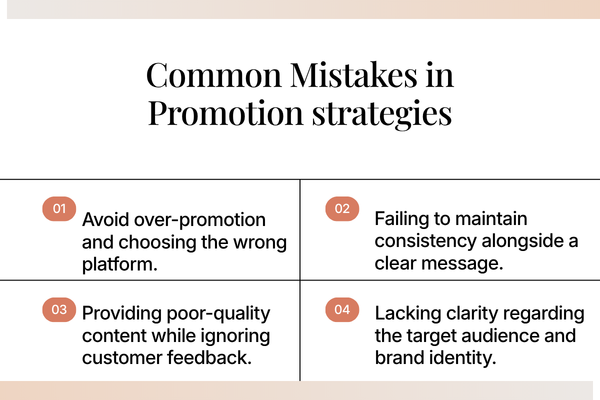
Common Mistakes in Promotion strategies
- Avoid over-promotion and choosing the wrong platform.
- Failing to conduct competitor analysis and budget planning is also a common mistake.
- Lacking clarity regarding the target audience and brand identity.
- Failing to maintain consistency alongside a clear message.
- Relying on a “copy-paste” strategy without including a Call-to-Action (CTA).
- Providing poor-quality content while ignoring customer feedback.
- Failing to develop a long-term strategy alongside proper analytics tracking.
The bottom lines
Promotion has become an essential component of modern-day business. Consequently, promotion strategies are utilized by virtually every business—whether small or large— and by all active marketers.
This article focuses specifically on promotion strategies, highlighting valuable information designed to help you achieve new milestones in your business. It covers key aspects such as importance, key characteristics, best strategies, advantages and disadvantages, and includes a section on Frequently Asked Questions.