
Email marketing is a powerful tool of digital marketing through which businesses generate maximum ROI. Welcome emails boast an open rate of 83%, and 93% of consumers check their email daily; consequently, email becomes an essential tool for business purposes.
Table of Contents
What is email marketing
Email marketing is a digital marketing method through which businesses reach their target customers or audience via email to directly deliver information regarding products, services, offers, or important updates. The advantage of email is that it enables direct, personalized communication with customers, while also being a cost-effective medium. Using email strategically, businesses can effectively generate leads and drive sales.
Types of email marketing
Newsletter Emails__ A newsletter is a common and effective form of email marketing, the primary objective of which is to build strong relationships with the audience and provide them with valuable information. Newsletters typically feature content related to the latest updates, blog posts, tips, industry news, or new company developments.
Lead Nurturing Emails__ Lead nurturing is a crucial form of email , the primary objective of which is to convert potential customers into paying customers by sending them a sequence or series of emails. Through lead nurturing emails, brands build trust and motivate customers to act by sharing helpful and informative content.
Transactional Emails__ Transactional emails refer to the automated follow-up emails sent to a customer immediately after they complete a specific task. These emails typically include details such as order confirmations, payment receipts, and shipping updates. The primary objective of this type of email is to build a long-term relationship with the customer.
Welcome Emails__ Welcome emails constitute a powerful component of email, serving as a highly effective tool for facilitating the initial interaction between brands and customers while simultaneously laying the foundation for future relationships. Typically, welcome emails are utilized for brand introductions, greeting the user, offering discounts on a first purchase, providing free trials, or granting access to exclusive content.
Brands primarily use Promotional Emails__ Promotional emails to promote their products, services, offers, or discounts. These types of emails feature sales-related content, such as new product launches, festive sales, discount coupons, “buy-one-get-one” offers, or flash sale announcements. The greatest advantage these emails offer a brand is the ability to communicate directly with customers, thereby boosting sales.
Re-engagement Emails__ Re-engagement emails are a form of email in which brands re-engage inactive or less active subscribers by sending special offers, discount coupons, exclusive updates, or personalized recommendations via email. When crafting a re-engagement email, keep certain factors in mind: the tone should be polite, warm, and inviting, and the content should be concise and engaging so that users can quickly grasp the purpose of the email.
Survey & Feedback Emails__ Survey and feedback emails constitute a crucial category of communication through which businesses enhance their customer experience. As part of this process, customers are solicited for feedback—including suggestions and assessments regarding product quality and delivery experiences—following an online order, thereby providing brands with genuine customer insights. These insights are subsequently utilized to refine future marketing strategies.
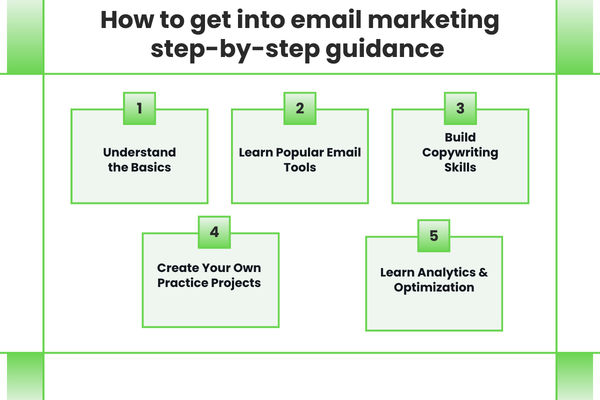
How to get into email marketing step-by-step guidance
Understand the Basics- To venture into email , one must possess a clear understanding of its fundamentals—specifically, that the primary function of email is to deliver your message to people, thereby informing and engaging them about your products or services with the ultimate goal of converting them into buyers. Furthermore, one should have a basic working knowledge of the various types of email marketing, key concepts, relevant metrics, and essential tools.
Learn Popular Email Tools- The second step in email is learning how to utilize its popular tools. These tools are highly useful for creating campaigns, managing subscribers, setting up automation, and tracking performance. A popular tool is Mailchimp, which offers templates, audience management, and basic automation features; Convert-Kit facilitates subscriber tagging; and HubSpot is highly effective for CRM, sales, and customer management.
Build Copywriting Skills- Copywriting is an essential skill in email , as it enables you to grab the reader’s attention and prompt them to act. In the process of developing copywriting skills, one should first focus on the subject line; subsequently, the body of the email should be crafted in simple and clear language to ensure a strong Call-to-Action (CTA).
Create Your Own Practice Projects- Once you have grasped the basic tools and skills involved in email , the next step is to undertake practical projects. This provides a deeper understanding of real-world processes and offers opportunities to learn new things—such as campaign planning, enhancing copywriting skills, and crafting audience-relevant messaging. For these practical projects, draft welcome emails and promotional emails to gain insight into various email styles and their specific purposes; additionally, incorporate elements like subject lines, CTAs, and email design concepts to build a comprehensive portfolio.
Learn Analytics & Optimization- In email , developing skills in analytics and optimization is crucial, as it is essential to both understand and improve your results. By mastering key analytics metrics—such as Click-Through Rate, Bounce Rate, Conversion Rate, Open Rate, and Unsubscribe Rate—and utilizing optimization techniques like A/B testing, you can make data-driven decisions.
How to Maximize ROI for Businesses Through Email Marketing: Practical Tips
Turn Emails into Revenue Machines ~ In the digital era, businesses are leveraging emails to generate sales and revenue, thereby achieving maximum ROI. The first tip is to transform your emails into “Revenue Machines”—a process that hinges on various factors. These include understanding your audience to facilitate the sending of personalized emails that boost conversion rates, crafting strong, attention-grabbing subject lines, and engaging in continuous testing and optimization to ensure sustained growth.
Boost Your ROI with Smart Email Strategies ~ The planning and execution of sound strategies indirectly help boost ROI (Return on Investment). This process involves focusing on the targeted audience to deliver personalized automated emails—such as welcome emails, follow-ups, and abandoned cart reminders—thereby improving conversion rates. Furthermore, creating smart and engaging content fosters greater interaction and builds trust; additionally, it is essential to incorporate a strong CTA (Call-to-Action).
Convert Clicks into Customers Effortlessly ~ Tip #3 for businesses to achieve maximum ROI through email marketing involves following an effective strategy to convert clicks into actual customers. This process entails building strong trust by utilizing clear messaging, professional design, and genuine offers; optimizing email landing pages to ensure fast loading speeds and clear, informative content; and boosting conversions—thereby reinforcing purchase decisions—by incorporating social proof such as customer reviews, ratings, or testimonials.
Make Every Email Count for Maximum Profit ~ To achieve maximum ROI in business, adopt a strategic approach to email marketing to ensure that the right message reaches the right person. Utilize storytelling to build an emotional connection with customers, thereby accelerating their buying decisions. Additionally, you can boost revenue by employing powerful techniques that create a sense of urgency and scarcity—such as “Limited Time Offer” or “Only a Few Left.”
Drive Sales Faster with Powerful Email Campaigns ~ Email campaigns represent a game-changing strategy for maximizing ROI, enabling you to quickly capture a customer’s attention and convert them into a buyer. To grab a customer’s attention, it is essential to generate curiosity and a sense of urgency, while simultaneously delivering immediate value. Concise and focused content serves as a powerful method for simplifying the decision-making process.
In summary
In the digital era, 78% of marketers utilize email, and 9 out of every 10 marketers prefer to conduct marketing via email. This blog shares valuable information regarding email marketing—clearly outlining the steps essential for its implementation—and covers key aspects such as generating maximum ROI for businesses, various types of email marketing, core metrics, analytics tools, advantages, and challenges.
Email marketing ( Frequently Asked Questions )
What are email strategies?
Email strategies represent an effective and smart approach through which brands formulate strategies to boost engagement, generate leads, and drive sales. Some well-known strategies include audience segmentation, personalization, catchy subject lines, valuable content, automation, and performance tracking.
Why is email important?
Email is essential for both business purposes and personal use, with the primary objective of making communication fast, professional, and reliable. Through email, tasks such as job applications, business deals, meeting invitations, official notices, and customer support—among others—are made possible.
Advantage of email marketing
The advantages of email marketing are cost-effective, customer relationship strong building, targeted communication providing, brand awareness increase, measurable results, customer retention, sales increase and global reach etc.
Challenge of email marketing
The challenges of email marketing include getting into the email spamming folder, risk of unsubscribe, high competition, low open rate, creating engaging content, data privacy and legal rules challenges, technical issues, email list maintenance, poor design, wrong targeting etc.
Example of Successful Email marketing campaign
Starbucks – Loyalty Program Emails- By devising a loyalty program campaign strategy to boost repeat purchases, Starbucks created a sense of urgency and exclusivity by clearly highlighting—via email—customer reward points, available offers, bonus stars, and limited-time deals and benefits. This approach successfully improved both repeat purchases and customer retention.
Nike – Storytelling Campaign- Nike stands as a prime example of successful email marketing, utilizing storytelling campaigns to highlight inspiration, motivation, and real-life struggles. This approach fostered an emotional connection between the brand and its audience, resulting in improvements in both engagement and conversions.
Spotify – Wrapped Campaign- The “Wrapped” campaign is a renowned Spotify strategy that curates a user’s annual listening habits—such as top songs, favorite artists, most-listened genres, and total listening minutes—in a manner that is both exciting and entertaining. Through this campaign, Spotify leveraged personalization and data-driven storytelling to boost user engagement, foster brand loyalty, and expand its overall reach.
Uber – Location-Based Promotions- Location-Based Promotion serves as an effective example of email marketing, wherein Uber devised a robust strategy involving the delivery of personalized emails—such as ride discounts, special offers, or suggestions for nearby destinations—to prompt users to take immediate action, thereby significantly enhancing both engagement and conversions.
Amazon – Abandoned Cart Emails- Amazon’s Abandoned Cart Emails serve as a successful example of a marketing campaign; through this process, Amazon sends reminder emails to customers who have added products to their carts, thereby encouraging them to complete their purchases. By effectively utilizing timely follow-ups, personalization, and a sense of urgency, the company significantly boosted both its conversion rates and overall sales.
Email metrics and analytic tools
Metricks:-
Bounce Rate: The email failed to reach the subscriber.
Conversion Rate: How many subscribers took a specific action.
Open Rate: How many subscribers read the email.
Click-to-Open Rate: How many clicks the email received.
Spam Complaint Rate: How many emails were categorized as spam.
Analytics tools:-
Mailchimp
Klaviyo
HubSpot
Brevo
Campaign Monitor
ActiveCampaign
All these tools track opens, clicks, bounces, unsubscribes, automations, and campaign performance.