
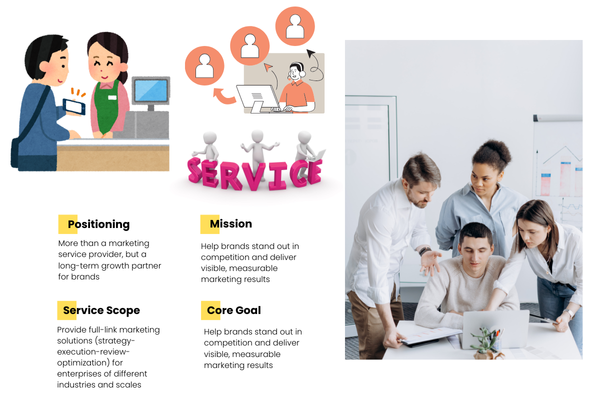
Today, we will discuss the elements of the service marketing mix in simple and easy-to-understand language, so that even a beginner can understand it.
If you want a detailed explanation of service marketing, this link will be very useful for you.
Table of Contents
What are the elements of service marketing mix?
Marketing serves as the backbone of any business, whether it’s a product or service-based business. Through marketing elements and strategic tactics, it effectively promotes products and services, creating brand awareness among customers and fostering brand loyalty. The service marketing mix simplifies the path to success for businesses.
Understanding the Elements of Service Marketing Mix
Nowadays, when anyone starts a business, they need to use service marketing mix methods to create awareness of their products and services among their target audience and customers in the market. This helps them establish a distinct brand identity. The service marketing mix method includes four traditional elements: product, price, place, and promotion. To make marketing even easier, three more elements have been added: people, process, and physical evidence, which help expand the product’s reach in the market.
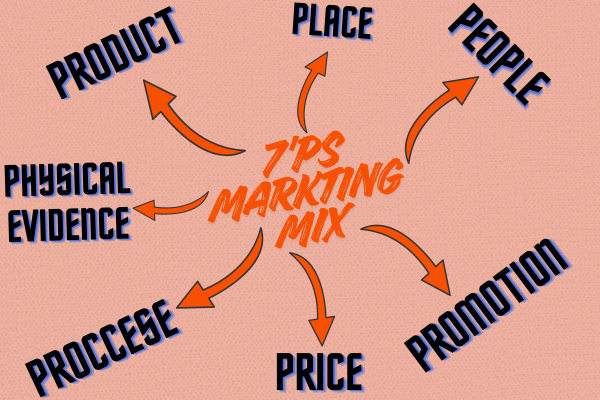
7 P’s of Service Marketing Mix with Examples
The seven elements of service marketing mix are explained one by one with examples for easy understanding.
1. Product–A product is not only a physical good but also a service that solves a customer’s problem. Examples of service products include education, healthcare, banking, hotels, and digital marketing. Products can also include physical goods that satisfy the customer. A quality service product creates value for the customer, which increases customer trust and loyalty towards the brand.
Example:-Apple is known for making mobile products with premium design, high security, and smooth performance.
2. Price–Price is an element where a business receives a certain amount in exchange for the products and services it provides. The price of a product or service depends on the customer’s perceived value, as pricing directly affects customer trust and satisfaction. Therefore, it is very important for businesses to set the right price so that customers feel they are getting value for their money. This also helps businesses stay ahead of competitors and maintain their competitive edge.
Example:-Zara’s clothing business offers great value at lower prices; this is its unique selling proposition (USP), which helps attract more customers.
3. Place–Place is a crucial element for businesses, and choosing the right location directly impacts their growth. It’s essential to provide the product or service at the right time, in the right place, and to the right customer. For products, this involves physical stores such as wholesalers and retailers, while for services, it requires establishing delivery channels like offices, branches, and franchises. The aim is to ensure customers can access the product or service with minimal difficulty.
Example:-Amazon is a popular company that distributes its products online and also makes the proxy simple and clear so that the trust of the customers can be built.
4. Promotion:-Promotion is an important part of marketing. Its main focus is to effectively increase awareness and visibility of a business’s products and services among people. There are two types of promotion: traditional and digital. Traditional methods include TV ads, posters, banners, and hoardings. Digital methods involve promotion through social media, SEO, and email.
Example:-Zomato is a food delivery-based business that uses promotions smartly and effectively, engaging users through methods such as funny social media posts, app notifications, and discount campaigns.
5. People–People act as pillars for a company or industry, whether it’s delivering a product or providing services; both depend on human interaction. This includes employees, staff, and service providers who enhance the customer experience. When staff are well-trained, polite, and helpful, it directly affects brand image and loyalty, allowing businesses to grow in the long term.
Example:-Hotels enhance the customer experience by decorating and furnishing rooms well and providing services such as sleep comfort, hygiene, entertainment, and personal care.
6. Process–In the service marketing mix, process is the element that involves creating a system to guide a service in the right direction, ensuring transparency and smooth interaction between businesses and customers. Technology, such as automation, apps, and CRM systems, is used to increase process efficiency, reduce errors, and build customer trust.
Example:-Ola aims to make processes like booking a cab, viewing driver details, tracking the trip, and making digital payments smooth and fast, saving customers both time and energy.
7. Physical evidence–Physical evidence presents intangible services in a tangible form. Unlike products or goods that we can touch, services are intangible. Its main purpose is to provide customers with proof of service quality. This includes elements such as office ambiance, building design, interior, cleanliness, salons, parlors, air travel, and buses. Physical evidence builds customer confidence and trust.
Example:-Apollo Hospitals maintains its physical evidence very well, such as beautiful infrastructure, clean waiting areas, best medical equipment, well-trained and uniformed staff, and reports kept in a proper format, etc.
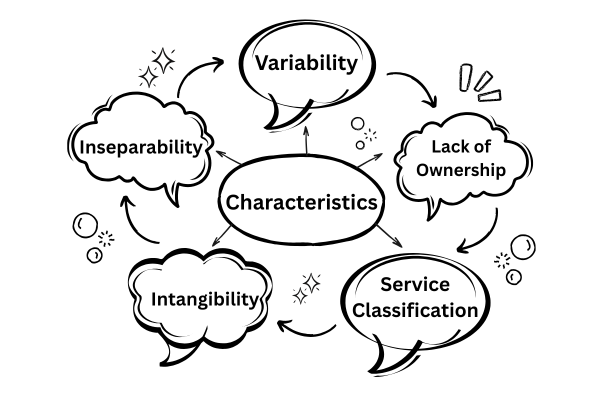
Characteristics of service marketing mix
The characteristics of the service marketing mix are covered in 5 points.
1. Intangibility—Intangibility means something that people cannot touch or feel like physical goods; it can only be experienced, such as services. For example, hotel stay, airline trip or education. Customers gather detailed information from promises, reviews, branding and past experiences before choosing a service. Businesses use physical evidence such as ambiance, staff uniforms, certificates, and online ratings to build customer confidence.
2. Inseparability—In the process of inseparability, both the service provider and the customer must be present because the service cannot be produced in advance, such as a guest’s stay in a hotel, a haircut in a salon, or teaching in a classroom. The focus of these services is on personalization, relationship building, employee training, and customer interaction. Furthermore, the quality of the service depends on the staff’s behavior, skills, and attitude.
3. Variability (Heterogeneity —Businesses find it difficult to consistently provide the same experience to every customer because customer experiences vary and change based on factors such as time, quality, and situation. To solve these problems, businesses use staff training, automation, and technology. Maintaining quality business services and customer experience strengthens the brand image and increases customer loyalty.
4. Lack of Ownership—When customers purchase physical goods, they become the owners of those goods, but this is not the case with services. In the case of services, customers only experience the service, such as therapy, haircuts, travel, and hotel stays. To encourage repeat purchases and build customer loyalty, businesses focus on relationship building, after-sales support, and consistent quality to ensure a positive customer experience.
5. Service Classification—To make services easier to understand and manage, they have been divided into categories. The first is customer services, which includes salons, beauty parlors, hotels, and banking. The second is business services, such as advertising agencies, IT services, consulting, and logistics. The third is equipment services, which includes ATMs, crockery, glassware, etc. Service classification helps marketers strategize.
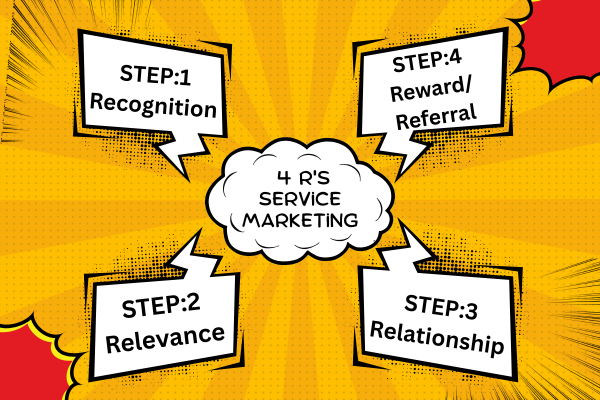
What are the 4 R’s of service marketing?
Recognition–Recognition is a marketing framework through which businesses make their customers feel that they are a top priority. They give loyal customers special treatment such as discounts, birthday wishes, exclusive offers, or early access, which builds trust, encourages repeat purchases, and also leads to customers generating positive word-of-mouth for the brand.
Relevance–Relevance is an element of marketing through which businesses can present products or services to their customers at the right time, based on their interests, behavior, and mood. Relevant marketing leads to increased customer engagement, resulting in higher click-through rates, conversions, and customer satisfaction.
Relationship–Building strong relationships with customers is a crucial factor for any company or industry because it strongly builds a long-term connection between the customer and the brand. The advantage of this relationship is that customers are less likely to trust other brands, which automatically leads to repeat purchases, conversions, and leads.
Reward/Referral–A reward or referral program is a powerful marketing strategy where businesses run a referral program for their loyal or existing customers. Customers refer the brand to their family, friends, and relatives through word-of-mouth or social media. When customers complete these activities, the brand rewards them with things like discount coupons, exciting gifts, phones, and more. This reward or referral system generates trust and loyalty, allowing the business to grow in the long term
examples of a service marketing mix?
1. Hotel : Hotel service is a basic example of a service known for providing room services. It not only provides rooms but also adds services such as sleep comfort, hygiene, food quality, entertainment, and personal care, which enhances the customer experience. The booking process is simple; you can book physically or digitally. You can check prices and reviews through the app and select your preferred rooms.
2. Digital Marketing Agency : A digital marketing agency is a service that helps brands grow online through digital platforms such as SEO, social media marketing, content marketing, Google Ads, and email marketing. They charge a fee for these services, which are typically offered in basic, standard, and premium packages, each with different services included. The agency’s main focus is to understand the client’s business goals and help them reach their target audience digitally.
3.Education Institute : An educational institution is a service that strengthens and advances the education system. It academically empowers students through institute courses, curriculum, practical learning, and exams. Its focus is on providing quality education. With the help of experienced teachers, modern educational institutes, digital tools, smart classes, online learning platforms, and study materials, students are prepared to achieve growth in their careers.
4. Airline : The airline provides passengers with a safe, fast, and comfortable travel experience on both national and international routes. It offers passengers three types of seating options: economy, business, and first-class, each with different costs and services. The airline makes ticket booking easy and smooth through websites, mobile apps, and travel agents.
5. Salon / Beauty Parlor : A salon or beauty parlor is a personal service establishment that provides grooming, beauty, and relaxation services. Salons offer services such as haircuts, hair spas, facials, makeup, manicures, pedicures, and skin treatments. These services can be availed through offline stores or online booking. Regarding pricing, it depends on the type of service. Basic services are low-cost, while advanced services are more expensive.
Conclusion:-
The rule of business these days is “no marketing, no sales.” This means you can’t sell many products or services without marketing, and you won’t generate conversions or leads. In this article, we will understand the elements of marketing and the service marketing mix in simple language so that even a beginner can understand and implement them in their business. We will also understand the characteristics and the 4 R’s of the service marketing mix.
3 thoughts on “Elements of service marketing mix; for beginners ”