
A D2C marketing strategy proves effective in helping businesses grow rapidly. Today, we will try to understand it through 10 strategies.
You can also learn about the 10 core concepts of marketing fundamentals.
Table of Contents
What is the impact of data collection on a dtc marketing strategy
In D2C marketing strategies, data collection is a game-changer asset for businesses because in D2C, brands interact directly with customers. This allows them to collect customer data such as behavior, purchase history, browsing patterns, preferences, feedback, interests, and spending habits. Brands then use this data for personalized marketing. The biggest advantage of data collection is that it allows for data analysis, which improves decision-making and enhances the customer experience, automatically leading to improved ROI.
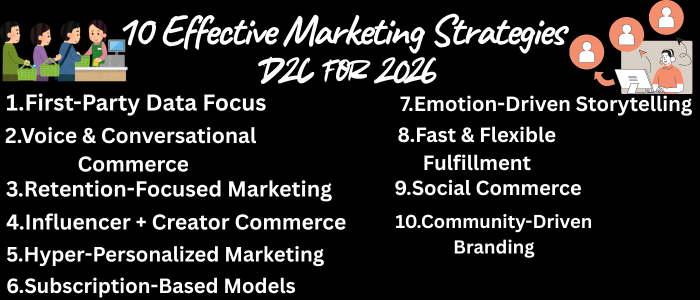
10 Effective Marketing Strategies D2C for 2026
First-Party Data Focus:-First-party data refers to the data that a brand collects directly from its customers when they interact with the brand. This includes data such as website visits, app usage, purchase history, email sign-ups, preferences, feedback, and loyalty program data. Based on all this data, customers are provided with personalized experiences, which improves both conversion rates and customer satisfaction. First-party data also strengthens customer segmentation and retention strategies.
Voice & Conversational Commerce:-The biggest advantage of voice and conversational commerce is convenience and speed. D2C businesses use this strategy to grow their brands quickly. Customers can search, compare, and order products by speaking or sending messages through voice assistants and chat-based platforms. Conversational commerce allows brands to provide 24/7 customer support, which increases trust and satisfaction.
Retention-Focused Marketing:-The main purpose of retention-focused marketing is to keep customers engaged with the brand for a long time because it costs less for brands to encourage repeat purchases from existing customers than to acquire new ones. Businesses build trust with customers and foster brand loyalty by using loyalty programs, reward points, referral offers, and exclusive member-only deals. Personalized email marketing, WhatsApp updates, and re-engagement campaigns also strengthen customer retention.
Influencer + Creator Commerce:-Influencer + Creator Commerce is a smart and powerful marketing strategy for D2C businesses. Businesses leverage influencers and creators to promote their products and services, generating direct sales. Micro and nano influencers generate high engagement, and creators maintain strong trust and emotional connections with their audience. Influencer + Creator Commerce provides brands with higher engagement, better conversion rates, and strong brand awareness.
Hyper-Personalized Marketing:-Hyper-personalized marketing proves to be a game-changer for any business. In this approach, businesses categorize customers based on their data, recommending products or services according to their interests and behavior. Brands use personalized ads, emails, and WhatsApp messages to significantly improve customer engagement and conversion rates, while also enhancing the overall customer experience.
Subscription-Based Models:- subscription-based models, companies run special campaigns for their loyal customers, charging a fixed amount on a monthly, quarterly, or yearly basis. In return, customers receive information about new products, cashback, discount coupons, and other premium features such as beauty boxes, grooming kits, health supplements, or daily essentials. These benefits are available only to subscribing customers, allowing companies to personalize the experience and retain their customers.
Emotion-Driven Storytelling:-Storytelling is a powerful strategy for brands that builds long-term customer relationships. In this approach, brands share their journey, values, struggles, and customer experiences through stories, which creates an emotional connection with customers and builds trust. These stories are also relevant to customers, highlighting emotions such as sustainability, self-care, confidence, or family values.
Fast & Flexible Fulfillment:-In the Fast & Flexible Fulfillment model, businesses design their logistics and supply chain to ensure quick order delivery and reduced lead times, such as same-day or next-day delivery, because customers expect fast delivery and convenience. Flexibility involves offering multiple delivery choices, such as preferred delivery slots, easy returns, exchange options, and cashless refunds, which helps build transparency and trust.
Social Commerce:-In social commerce, brands use online platforms like Instagram, Facebook, YouTube, and WhatsApp to make the product buying journey shorter and smoother for customers. D2C brands promote and sell products directly through influencers and creators. The biggest advantage of this is that customers can make impulse purchases. Instant interaction with customers through comments, DMs, and live chats allows for immediate clarification of their doubts, leading to better engagement, higher conversions, and a stronger community.
Community-Driven Branding:-Community-driven branding proves to be an effective and differentiating factor for D2C brands. In this model, brands promote two-way interaction with customers through social media groups, WhatsApp communities, Discord servers, and offline meetups to build a strong emotional connection and bond with them. They also make customers feel valued by giving importance to their feedback and reviews.
Importance of marketing strategy in modern business
In today’s modern business world, a marketing strategy plays a crucial role in achieving success because simply offering the best quality products and services is no longer enough; it’s also essential to reach the right customers. A strong marketing strategy allows brands to analyze the needs, wants, preferences, and buying behavior of their target audience and provide them with personalized offers and relevant content. It also provides businesses with a clear direction, enabling the company to achieve its goals. A well-planned strategy is cost-effective and saves time.
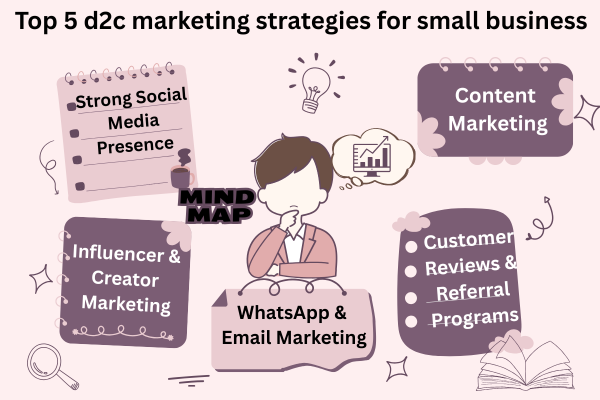
Top 5 d2c marketing strategies for small business in India
1.Strong Social Media Presence:-Social media presence acts as a powerful pillar for small businesses. Through social media platforms like Instagram, Facebook, YouTube, and even LinkedIn, brands interact directly with customers. Brands don’t just use these tools for promotion; they also respond to customer queries instantly through comments, DMs, and live sessions, which enhances the customer experience. They also build trust by posting engaging content on a regular basis.
2.Influencer & Creator Marketing:-Including influencers and content creators in marketing strategies is highly effective for small businesses because it delivers high engagement and credibility even on a low budget. Influencers and creators have already built trust and connections with their audience, making it easier for brands to increase awareness and visibility. Additionally, creators naturally promote brands through product reviews, unboxing videos, reels, and honest recommendations.
3.WhatsApp & Email Marketing:-WhatsApp and email marketing are among the most effective tools for brands. Small businesses use these tools to connect directly with customers and generate sales. Through WhatsApp messages, they instantly reach customers with order updates, exclusive offers, cart reminders, and product launches. Email marketing helps strengthen customer retention and encourage repeat purchases. Brands can achieve a high return on investment (ROI) with email and WhatsApp marketing, even on a low budget.
4.Content Marketing:-Content marketing is part of a smart and unique marketing strategy. Its main purpose is to provide customers with information and valuable content. When brands regularly post useful content on social media, such as educational, informative, entertaining, and problem-solving content, it generates customer trust. Consistently posting useful content also generates organic reach and engagement.
5.Customer Reviews & Referral Programs:-Customer reviews play a crucial role for small businesses. When customers share positive reviews, such as experience reviews, ratings, photos, or videos, it strengthens the brand image and builds trust among new customers. Furthermore, through referral programs, brands attract customers by offering incentives like refer and earn programs, ₹100 cashback, and many other exciting offers, which also leads to word-of-mouth promotion.
Examples of successful D2C brands
🔹Mama-earth (India):-Mama-earth is a very successful D2C brand in India that sells skincare products directly to its customers through its website and app. Mama-earth’s marketing strategy focused on providing value to customers by sharing educational and informative content related to skincare. They also built trust in their brand based on the concept of toxin-free, natural, and chemical-free products. To increase repeat purchases, they focused on fast delivery, strong customer reviews, and affordable pricing.
🔹Warby Parker (USA):-Warby Parker is a D2C brand from the USA that revolutionized the eyewear industry by bypassing traditional optical stores and adopting a direct-to-consumer model. Warby Parker focused on a strong digital presence, clean website design, and a smooth online experience, which automatically built customer trust in the brand. Their marketing strategy included a Home Try-On Program, where customers could try five frames for free at home, which further instilled trust and confidence in new customers.
🔹SUGAR Cosmetics (India):-SUGAR Cosmetics is also a successful D2C brand. They understood the gap in the beauty market and specifically targeted young, bold, and confident women, offering them the perfect balance of affordable pricing and premium quality products. To establish an offline presence, SUGAR launched exclusive brand stores and kiosks, which increased both trust and visibility. They also generated sales online through their app and website. Direct access to customer data, preferences, and feedback allowed them to further innovate and improve their products.
🔹Casper (USA):-Casper is a popular D2C brand in the USA that sells mattresses and sleep products. The buying process for mattresses in the USA was considered complex and confusing. Casper solved this problem in a simple and effective way by introducing a 100-night free trial and an easy return policy, building trust and confidence among existing and new customers. They made their brand successful through a strong marketing strategy and creative advertising.
🔹Boat (India):-boAt is an Indian D2C consumer electronics brand that manufactures earphones, headphones, and smartwatches. They have adopted a direct-to-customer model to create a strong brand identity in the market. boAt’s biggest strength is its cool, relatable, and desi branding. With a combination of affordable pricing, stylish design, and good sound quality, boAt has attracted customer attention. boAt has also smartly and aggressively used celebrity and sports marketing to make its brand one of India’s top D2C brands.
Conclusion:-
D2C (Direct-to-Consumer) is a popular marketing strategy used to accelerate business growth. In this article, we will discuss this method, providing you with information on its definition, types, and importance. This information will be useful when creating your marketing strategy. We will also explain 10 marketing strategies in detail that can be used to simplify your marketing journey.
D2C Marketing strategy FQAs
What is D2C marketing strategy
In the D2C (Direct-to-Consumer) marketing strategy concept, brands sell their products and services directly to customers without any intermediaries such as brokers, distributors, or retailers. The main purpose of D2C marketing is to build customer relationships, maintain brand control, and own customer data. By leveraging digital technologies like websites, mobile apps, and social media, brands stay connected with customers. They use first-party data and performance analytics to create personalized offers, targeted ads, and a better customer experience. Overall, the D2C marketing strategy provides brands with cost-effective, customer-centric, and scalable growth.
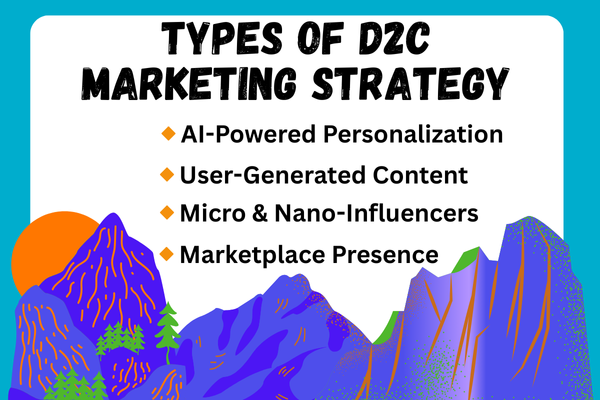
Types of D2C marketing strategy
🔸AI-Powered Personalization–AI is an advanced and powerful tool for D2C marketing strategies, making it easier for brands to achieve their target goals. This process uses Artificial Intelligence and Machine Learning to analyze each customer’s browsing behavior, purchase history, search patterns, location, and interests, providing personalized offers and experiences. AI-powered chatbots offer customers 24/7 instant support, making the customer’s purchasing journey smoother.
🔸Marketplace Presence–Using a Marketplace Presence strategy, brands list their products on online marketplaces like Amazon, Flipkart, Myntra, and Meesho, while also maintaining their own website/app to achieve maximum visibility and fast customer reach. For new or emerging brands, marketplaces serve as a quick entry point, enabling them to reach a large customer base with low marketing costs.
🔸User-Generated Content–User-generated content refers to content created by customers for a brand. This content can be in the form of reviews, testimonials, unboxing videos, reels, photos, or social media posts, which automatically builds trust and authenticity for the brand. Brands motivate customers to create content through hashtags, challenges, contests, and rewards because in today’s digital era, customers trust the opinions of real users more than advertisements.
🔸Micro & Nano-Influencers–Micro and nano-influencers are those who have 1,000 to 100,000 followers. New brands especially utilize them for marketing their products and services because they are cost-effective and provide a high customer reach. The biggest unique aspect of micro and nano-influencers is that their audience is niche-specific, such as fitness, skincare, fashion, or technology. When a micro or nano-influencer gives an honest review of a product, their followers perceive it as a recommendation from a friend. This significantly increases the chances of conversion.
Why is it important for consumers to be aware of marketing tactics?
Understanding marketing tactics is very important for consumers because today there are ads, influencers, discounts, and persuasive messages everywhere, which helps customers understand the difference between brand claims and reality. Awareness of marketing tactics allows consumers to logically understand the real value, price, and quality of a product before making a purchasing decision. This is because brands often create pressure on consumers to buy their products or services through limited-time offers, fake scarcity, influencer promotions, sponsored content, and hidden charges.
Why do need marketing strategy
A marketing strategy gives a business a competitive advantage and provides clear direction and focus. Good positioning and messaging create a distinct identity for the brand in the market, and a better marketing strategy helps in efficiently managing resources such as budget, channels, and campaigns, resulting in a better return on investment (ROI). Furthermore, a strategy ensures consistent brand communication and clarifies the customer’s product purchasing journey. Overall, a marketing strategy provides a business with growth, sustainability, and scalability.
Key Metrics to Track marketing strategy
1️⃣ Brand Awareness Metrics–Brand awareness metrics measure how much reach, visibility, and recognition a brand is achieving in the market, using website traffic as an indicator. The main purpose is to reach more people and strengthen the brand identity.
2️⃣ Engagement Metrics–Engagement metrics measure how much the audience is interacting with your content through elements like likes, comments, shares, and saves, and also measure metrics like time spent on page and bounce rate on the website.
3️⃣ Lead Generation Metrics–Leads Generated is the most basic metric that shows how many people are filling out forms, signing up, requesting demos, or making inquiries, and Lead Source Tracking reveals which channel (social media, Google ads, email, referral) is bringing in the most quality leads.
4️⃣ Sales & Revenue Metrics–Sales and revenue metrics are an important part of businesses because sales and revenue growth directly indicate whether or not the business is growing. Marketing campaigns help determine the customer acquisition cost, which means how much it costs to connect with one customer and get them to engage with the brand.
5️⃣ Retention & Loyalty Metrics–Retention and loyalty metrics are a crucial part of any marketing strategy. Brands build trust by providing valuable products and services to their customers, strengthening the relationship between them and ensuring long-term customer loyalty and repeat purchases. Retaining existing customers is also less expensive than acquiring new ones.