
As digital technology changes, artificial intelligence (AI), meaning artificial entanglement, will dominate. More humans will use AI-based devices, as well as how it will impact marketing. Let’s explore this in detail.
Table of Contents
How much AI is used in marketing?
Digital presence is growing rapidly, and brands are using artificial intelligence (AI) tools to make their marketing strategies smarter and more efficient. AI analyzes customer data to understand customer behavior, activities, and interests. Let’s explain this through a few points.
1️⃣ Data Analysis & Insights:-Through marketing, businesses have access to a lot of customer data, such as buying behavior, browsing history, interests, location, and feedback. AI tools utilize all this data to perform deep analysis and extract insights, making it easier for marketers to make decisions.
2️⃣ Personalization:-Personalization focuses on the demands of individual customers, as everyone has different needs. AI solves this problem by analyzing customer behavior, search history, purchase patterns, and interests to display customized offers and recommendations, such as suggesting products on an e-commerce website. It is also considered the heart of marketing in modern trends.
3️⃣ Chatbots & Customer Support:-In the coming times, chatbots will be dominant, and they can prove to be a game-changer for businesses because they are available 24/7 for customer support. They instantly provide information on order status, return policy, payment issues, or product details, which saves customer time and also improves the brand’s service quality.
4️⃣ Social Media Marketing:-artificial intelligence (AI)has made social media marketing smarter and more powerful. AI enables automatic post scheduling, hashtag suggestions, and trending topic generation. Previously, content was posted based on guesswork, but now AI makes it easy to decide what type of content will generate the most reach and engagement on each platform.
5️⃣ Predictive Marketing:-Predictive marketing is the process by which brands use AI and data analytics to predict future trends. It involves deeply analyzing a user’s purchase history, browsing patterns, interests, and engagement activity to recommend products that meet their needs. For example, Amazon and Flipkart recommend products a customer has previously browsed or purchased.
What is the 30% rule in AI?
The 30% rule in artificial intelligence (AI) is a guideline that means that in any task performed, 70% of the contribution should come from humans and 30% from artificial intelligence. This process is simple, and it’s especially important for startups, product developers, business owners, and freelancers to use AI responsibly. When working on projects, developing apps, writing code, or working on any specific development, they should ensure that no more than 30% of the work is done through AI tools. This is a threshold where the benefits and costs are balanced.
What is the best example of AI in marketing?
There are different types of marketing in various fields, and we have tried to illustrate some of these types through a few points. So, let’s begin.
AI-Powered Marketing Automation and CRM
1.salesforce:-Salesforce is an effective cloud-based technology that handles customer data, sales, marketing, and service. It is proving very useful for both small and large businesses today because it helps brands improve productivity, sales conversion, and customer satisfaction. Its Einstein AI is enhancing marketing campaigns by analyzing future predictions and customer behavior.
2.Adobe Market Engage:-Adobe Market Engage artificial intelligence (AI) is an automation platform used in businesses for lead generation, lead nurturing, email marketing, and customer segmentation. It helps improve marketing performance, increase ROI, and deliver business messages to target customers effectively. It supports multiple channels, including email, social media, mobile messaging, and paid ads.
AI for E-Commerce
3.Amazone:-Amazon is an e-commerce platform that uses AI to create a better customer experience and make marketing smarter, faster, and highly effective. AI is not limited to recommendations; it is also used for dynamic pricing, email marketing, and ad targeting. Furthermore, AI performs predictive marketing, such as anticipating what a customer might buy.
4.Wallmart:-Walmart is also a unique and powerful example, using AI to predict which products will sell best in which areas based on customer shopping patterns, location, and season. Their AI-powered mobile app sends users price drop alerts and offers from nearby stores, prompting users to purchase products immediately.
AI-Enhanced Advertising and Campaigns
5.Google:-Google’s strong point is its Performance Max and Smart Ads system. By incorporating AI, Google automatically runs ads across multiple platforms like Chrome, YouTube, Display Network, Gmail, etc. Google’s AI displays relevant ads based on users’ behavior, interests, location, and intent, reducing errors and increasing ROI “return on investment”.
6.Facebook:-Facebook also uses artificial intelligence (AI) to power its ad targeting and auto-optimization systems. This involves targeting interested audiences based on user likes, shares, comments, watch history, location, and online behavior data. In AI auto-optimization, the system automatically decides which ad creative, headline, or video will perform best to maximize engagement and reach.
AI in Social Media Marketing
7.Coca-cola:-Coca-Cola has enhanced its brand image by using AI to market itself in unique and effective ways on social media. They gain insights into audience sentiment and current perceptions of their brand across social platforms like Instagram, Facebook, Twitter, and YouTube. Based on this information, they use AI to run targeted ads, which increases both engagement and conversions.
8.Starbucks:-Like other major brands, Starbucks also uses AI very effectively in social media marketing. Specifically, through digital platforms like Instagram, Facebook, and X (Twitter), personalized offers, drink recommendations, and festive campaigns are shown to users. For example, reels and ads featuring cold drinks are automatically pushed during the summer, and those featuring hot coffee are pushed during the winter, all powered by artificial intelligence (AI).
note:-This article is related only to social media marketing. You can learn more details about it through the link provided.
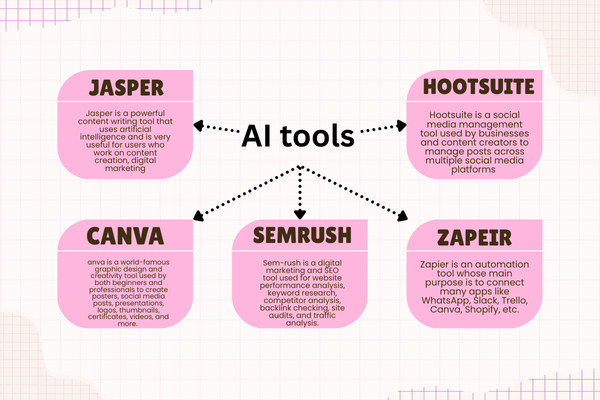
Best AI tool for marketing?
1.Jasper:-Jasper is a powerful content writing tool that uses artificial intelligence and is very useful for users who work on content creation, digital marketing, and copywriting. Its main function is to generate blogs, social media posts, ads, emails, and website content quickly and creatively. The benefits include its ability to write high-quality and SEO-friendly content, which can help websites rank higher in search engines.
2.Sem-rush:-Sem-rush is a digital marketing and SEO tool used for website performance analysis, keyword research, competitor analysis, backlink checking, site audits, and traffic analysis. Sem-rush helps marketers, bloggers, and business owners make data-driven decisions and makes online growth faster and smarter. Along with SEO, it also offers features for content marketing and social media tracking.
3.Canva:-Canva is a world-famous graphic design and creativity tool used by both beginners and professionals to create posters, social media posts, presentations, logos, thumbnails, certificates, videos, and more. With Canva’s drag-and-drop feature and AI features like Magic Design, Text to Image, and Background Remover, you can make your design journey easier. It also offers a wide variety of ready-made templates, fonts, stickers, and images.
4.Zapier:-Zapier is an automation tool whose main purpose is to connect many apps like WhatsApp, Slack, Trello, Canva, Shopify, etc., and automate tasks. Zapier can work with over 5000 apps. Students, freelancers, and marketers use it frequently because it saves time and reduces manual work. Its interface lets you set up automation workflows.
5.Hootsuite:-Hootsuite is a social media management tool used by businesses and content creators to manage posts across multiple social media platforms such as Facebook, Instagram, Twitter, LinkedIn, YouTube, etc., from a single location. Hootsuite’s main functions include post scheduling, content planning, tracking analytics, and monitoring audience engagement. These features make social media management strong and effective.
Conclusion:-
Artificial intelligence-based technologies will be a crucial part of marketing in the future, and many brands have already started using them. It’s a type of robot, both digitally and physically, that can perform tasks like a human, or even better and more accurately. This article describes how artificial intelligence will change or influence marketing methods and how you can learn about it in detail to utilize it in your business or career.
FAQ(Frequently Asked Questions)
What is artificial intelligence AI?
Artificial intelligence is a technology based on designing, thinking and making decisions like humans. It learns things using machine learning and deep learning. Today, AI use has increased significantly. You can see it in mobile voice assistants (Siri, Google Assistant), face recognition, online shopping recommendations, self-driving cars, medical diagnosis, and many other areas.
The different types of AI?
We will explain seven types of artificial intelligence that are considered mainstream.
- General AI (Strong AI)–This is a special AI system that is capable of thinking, understanding, learning, and providing unique solutions to all kinds of problems, just like a human. It can also engage in future imagination, creativity, experience emotions, and make self-decisions.
- Super-intelligent AI–In the future, super-intelligent artificial intelligence (AI) will be far more powerful than humans, easily surpassing them in science, technology, creativity, and many other fields. However, this also means it could lead to either a revolution or significant future risk.
- Reactive Machines–Reactive machines are the basic level of artificial intelligence (AI), used in applications where a response is required, such as in self-driving car sensors, real-time traffic monitoring, speed, and distance calculations. They analyze data from the current situation and react accordingly, but they neither have the ability to store memory nor can they learn from past experiences.
- Limited Memory–Reactive Machines was the basic level, but Limited Memory AI is an advanced version that uses temporary data or short-term memory to better predict future actions. Its advantages include better accuracy, learning ability, and improved performance, etc.
- Theory of Mind–Theory of Mind is an advanced feature whose main focus is that whatever a human is feeling—whether upset, happy, or confused—the AI can respond accordingly. In the future, you may see AI-powered doctors, nurses, teachers, and counselors who can play a role in customer service.
- Self-aware AI–Self-aware artificial intelligence (AI) can not only understand human emotions and behavior, but also comprehend existence, thoughts, and feelings. It is capable of highly intelligent problem-solving, accelerating scientific research, and making complex real-time decisions. Furthermore, it can create its own emotions such as fear, happiness, sadness, or ambition.
- Machine Learning (ML)–Machine learning is the most important part of AI. Its algorithms analyze data to identify patterns and then make decisions based on those patterns. Examples include Netflix and YouTube’s recommendation systems, which provide relevant content based on watch or search history. Machine learning and AI are considered the backbone of the future.
How does AI learn?
artificial intelligence (AI) learns through data; its learning process is very similar to how humans learn, through experience and practice. AI gathers information from images, text, videos, or numbers, etc., and identifies patterns in this data to perform supervised, unsupervised, and reinforcement learning.
What is ChatGPT?
Chat-GPT is a modern artificial intelligence (AI) chatbot feature that analyzes the user’s natural or modern language questions and provides answers in a simple, smart, and meaningful way. It relies on Machine Learning and Deep Learning techniques. Users can use it to learn about education, content writing, coding help, business strategies, marketing guidance, translation, creative writing, doubt solving and more.
What is an AI server?
artificial intelligence (AI) servers are powerful computer systems designed to run, train, and manage applications and machine learning models. Compared to other servers, AI servers utilize faster, high-performance hardware to easily handle heavy data processing, such as GPUs (Graphics Processing Units), TPUs (Tensor Processing Units), and high RAM and storage. They are used to train chatbots like Perplexity, Chat GPT, and Gemini.
4 thoughts on “How artificial intelligence will change the future of marketing”