
Organic marketing strategies offer an authentic way to increase traffic—either for free or without any investment. In the long run, they foster strong customer relationships and ensure sustainable trust, both of which are essential for continuously generating organic traffic.
Growing your brand naturally through organic marketing requires patience, dedication, and a deep understanding.
In this article, you will find a detailed explanation of valuable and useful topics.
Let’s dive in.
Table of Contents
What is organic marketing strategies
Organic marketing strategies represent a proven—and inherently natural—method for achieving growth, one that does not require the use of paid advertisements.
There are various types of organic marketing—such as Personal Branding, Content Marketing, Email Marketing, Guest Posting, and Collaborations—all of which play a pivotal role in attracting and retaining an audience.
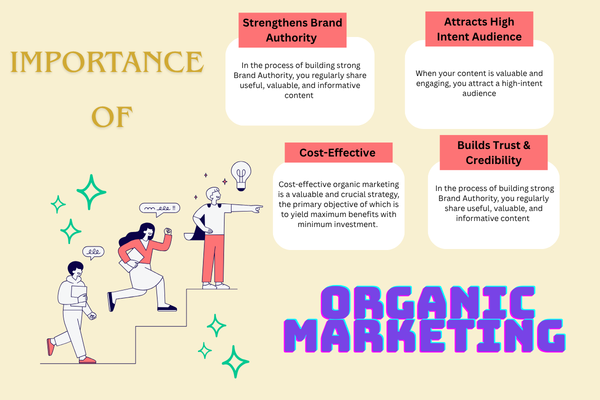
Importance of organic marketing
In a highly competitive market, organic marketing plays a crucial role in ensuring sustainability by keeping budgeting under control—a factor that proves particularly beneficial for small and new businesses.
Some key points regarding this have been outlined below.
Strengthens Brand Authority – In the process of building strong Brand Authority, you regularly share useful, valuable, and informative content across various formats—such as blogs, videos, or social media posts—to make your audience feel special and valued. This establishes your identity as a specific expert in your field, while receiving likes, shares, and comments on your content further boosts your credibility.
Attracts High Intent Audience – When your content is valuable and engaging, you attract a high-intent audience. This audience is actively seeking products or services to find a solution to their needs. The benefit of a high-intent audience is that it yields a high conversion rate, making it easier to convert them into customers.
Cost-Effective – Cost-effective organic marketing is a valuable and crucial strategy, the primary objective of which is to yield maximum benefits with minimum investment. This process demands additional time, effort, and creativity, alongside the necessity for patience and dedication.
Builds Trust & Credibility – Trust and credibility serve as the pillars of a brand’s growth. In the process of building these two elements, a problem-solving approach is employed to post helpful and informative content; this naturally fosters trust, while simultaneously boosting engagement rates—thereby establishing credibility.
Top 10 organic marketing strategies
- Email Marketing _ Email marketing is an organic marketing strategy that delivers a high Return on Investment (ROI). Through emails, businesses engage in direct communication with their audience to build strong connections. In this process, email lists are curated to send customized emails tailored to users’ behavior, interests, and past interactions, thereby automatically boosting open rates and conversion rates.
- Content Marketing _ Content Marketing is a sustainable method within organic marketing strategies that aims to build trust, attract, and engage a target audience by providing them with valuable information. In this strategy, a brand identifies the audience’s problems and customizes content—tailored to their specific needs—in formats such as blog posts, videos, infographics, and podcasts, often incorporating storytelling; this is done to maximize reach and foster trust and loyalty.
- Personal Branding _ In the realm of organic marketing strategies, personal branding serves as a smart approach for establishing strong authority and building a distinct identity. Through this approach, an individual shares useful insights, skills, knowledge, and real-life experiences relevant to their niche, thereby delivering value to their audience. This process facilitates the development of their persona as an expert, while simultaneously enhancing both the visibility and credibility of their brand.
- Search Engine Optimization(SEO) _ Search Engine Optimization plays a crucial role in organic marketing strategies. Its primary objective is to generate free organic traffic by helping a website rank at the top of search engine results. This strategy involves the proper optimization of three distinct types of SEO: On-page SEO (optimizing content, headings, meta tags, and images), Off-page SEO (focusing on backlinks), and Technical SEO (managing website speed, mobile-friendliness, and proper site structure)—all of which serve to boost overall performance.
- Repurposing Content _ Content repurposing is a smart and cost-effective organic marketing strategy in which a single piece of content is redesigned into multiple formats and shared across various online platforms to achieve maximum reach and engagement. A major advantage of this approach is that it saves both time and effort, and it enables you to reach diverse audiences.
- Social Media Marketing _ Social Media Marketing is a powerful method within the realm of organic marketing strategies, utilized by businesses to boost brand visibility and awareness through platforms such as Instagram and Facebook. A crucial factor in this strategic approach is selecting the right platform, as different platforms cater to distinct types of audiences. To continuously boost engagement, it is essential to create and post content that is both engaging and valuable, thereby ensuring that the audience’s attention remains captured.
- Guest Posting & Collaborations _ Guest posting and collaborations constitute a high-performance approach within organic marketing strategies that proves highly effective for expanding your reach. Through guest posting, publishing articles on other websites allows you to reach new audiences while simultaneously generating backlinks—a crucial element for SEO that helps improve your search engine rankings. Collaborations involve partnering with creators within your specific niche to produce videos, podcasts, webinars, or social media content, thereby enhancing both your mutual visibility and credibility.
- Influencer Collaborations (Organic) _ Influencer collaboration is the best method for increasing organic reach and traffic, serving as a key organic marketing strategy. By employing this strategic approach, influencers build audience trust in an authentic manner, as genuine recommendations tend to be far more impactful than video advertisements. This process typically involves two influencers working together to jointly create videos, reviews, live sessions, or other informative and useful content for social media platforms.
- Referral & Word-of-Mouth Marketing _ Referral and Word-of-Mouth Marketing are powerful and cost-effective strategies. In a referral program, brands encourage existing or loyal customers to actively promote the brand through discounts, rewards, or cashback offers—a method that is inherently trusted. Word-of-Mouth marketing, on the other hand, builds a strong brand identity by sharing positive reviews, ratings, and testimonials from the audience, serving as an effective way to attract new customers.
- Community Building _ Community building is a trust-driven strategy primarily aimed at significantly boosting engagement and brand loyalty over the long term, wherein trust and transparency prove to be key factors. The process of community building involves targeting an active audience to establish communities, fostering regular discussions where members can share their ideas and real-life experiences—thereby making them feel special and valued—and maintaining engagement by providing exclusive content, tips, and resources.

3 advantage & challenges
Effective organic marketing strategies play a crucial role in achieving successful brand growth. This process entails numerous advantages and challenges, some of which are explained in the points below.
Advantage :-
Scalable Growth – Scalable growth is a key advantage of organic marketing strategies. To achieve it, brands consistently share useful, engaging, and relevant content to create value for the audience and ensure that reach continues to expand organically. SEO and discoverability also play a supportive role in facilitating this scalable growth.
Better Targeting – A key advantage of organic marketing is superior targeting; by identifying the audience’s interests, problems, and needs—and basing this on their age group, location, behavior, and purchasing patterns—brands can address their issues through helpful content, thereby enhancing audience understanding.
Measurable Performance – Achieving measurable performance is a major advantage of organic marketing strategies. By leveraging this advantage, brands utilize analytics tools and metrics to analyze growth. This involves rigorous tracking and the use of data-driven insights to optimize strategies and strengthen decision-making.
challenges :-
High Competition – In the realm of organic marketing strategies, high competition poses a formidable challenge that impacts online brand visibility and credibility in various ways. Consequently, it necessitates addressing several specific challenges, such as algorithm dependency, SEO competition, the pressure for consistency, building audience trust, and content saturation, among others.
Budget Management – Budget management poses a major challenge in organic marketing strategies, particularly for small and new businesses. Achieving growth requires a minimum level of investment—specifically in areas such as content creation, tools, and manpower— and addressing issues related to resource allocation and scalability.
Requires Time & Effort – In organic marketing strategies, the requirement for significant time and effort—stemming from the need for zero or minimal financial investment—constitutes a major challenge. The impact of this challenge slows down growth, makes it difficult to maintain consistent effort, and complicates the task of balancing quality with quantity.
How to start organic marketing in 7 steps
Step 1: Select a Niche-Related Target Audience — A niche is essentially a specific subject around which you write and publish entire articles, thereby attracting an audience aligned with that topic.
Step 2: Build a Strong Brand Identity — A strong brand identity positions you as an expert in the eyes of your audience, playing a pivotal role in driving your overall growth.
Step 3: Create a Content Strategy — Achieving organic growth requires a sound content strategy, which proves invaluable in guiding your efforts in a positive and productive direction.
Step 4: Focus on SEO — SEO is a critical component for getting your website articles to rank at the top of search engine results. It involves properly optimizing your content according to SEO best practices to ensure that your reach and influence grow organically over the long term.
Step 5: Build a Social Media Presence — In this step, share content on a regular basis to establish a distinct identity across social media platforms such as Instagram, YouTube, and Facebook; consistency plays a key role in building this presence.
Step 6: Increase Engagement & Build Relationships — When you use your content to address your audience’s problems and make them feel valued, you strengthen your relationship with them and simultaneously improve your engagement rates.
Step 7: Maintain Consistency & Patience — Posting content consistently is crucial, but it must be accompanied by patience, as organic marketing growth is a long-term process with no fixed timeline for when growth will actually materialize.
successful brand examples of organic marketing
Nike :- Nike is a world-renowned sportswear brand that has infused innovation and emotion into its organic marketing campaigns to foster a connection with its audience and establish a unique brand identity within the market. Nike’s core focus lies in the performance of athletes.
Red Bull :- Red Bull is a globally popular energy drink brand that projects an adventure-driven identity through its advertisements. Employing organic marketing strategies, Red Bull designs its ads around themes of excitement and extreme experiences, thereby inspiring its audience to become energetic and fearless.
Duolingo :- Duolingo is a popular language-learning platform that has made the learning process simple and rewarding by employing a fun, engaging, and user-friendly approach within its organic marketing strategies; furthermore, by continuously improving its features and user experience, it has achieved a significant increase in engagement and conversions.
Apple :- Apple is a globally renowned brand for technology accessories, celebrated for its commitment to premium quality, innovation, and a minimalist design philosophy. Apple’s core strength lies in innovation—specifically, the integration of features and technologies that enhance the user experience. Furthermore, through a communication style characterized by clear and focused messaging, the brand effectively captures audience attention, thereby generating leads and driving conversions.