Paid marketing is a popular and vital resource that helps brands rapidly boost awareness and visibility, enabling them to effectively reach their potential or target audiences. Furthermore, compared to organic marketing, it demonstrates an immediate impact.
Between 64% and 73% of B2C and B2B (business to business)marketers strategically utilize paid advertising to generate maximum ROI. Companies typically allocate 50% of their marketing budget to running paid advertisements.
Table of Contents
What is paid marketing ?
Paid marketing is a powerful method. Through this approach—which involves financial investment—businesses promote their products and services to reach their target audience, thereby generating maximum engagement and leads that can subsequently be converted into conversions.
Its primary objective is to enhance brand awareness and visibility.
Some common types of paid marketing include Display Ads, Search Ads, Video Ads, and Social Media Ads, among others.
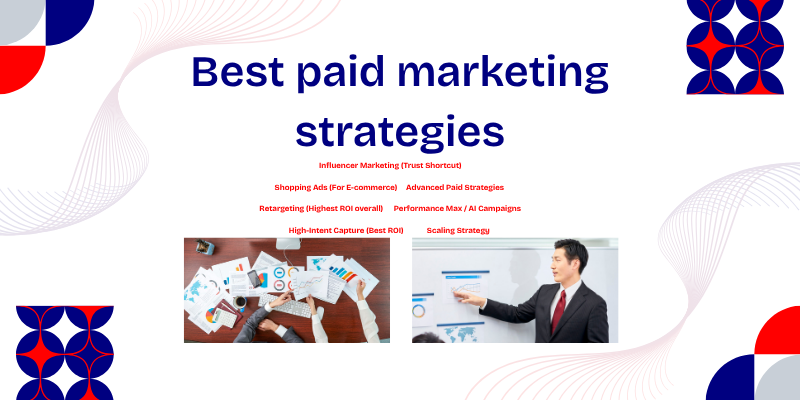
Best paid marketing strategies
Influencer Marketing (Trust Shortcut) _ Influencer marketing is an impactful marketing strategy that promotes products and services to boost engagement and conversions. This is because, nowadays, people perceive recommendations from real individuals as more genuine than traditional advertisements. Furthermore, brands engage in long-term collaborations with influencers to reach their maximum target audience, thereby strengthening brand recall and building trust.
Shopping Ads (For E-commerce) _ Shopping Ads represent a game-changing strategy utilized particularly by e-commerce businesses. This process involves displaying products directly within search results—complete with an image, price, and brand logo—on Google Ads or other online platforms. Optimizing product listings is highly beneficial, involving key factors such as the title, description, price, and category, to enhance overall performance.
Advanced Paid Strategies _ Advanced Paid Strategies constitute a smart approach that focuses on data-driven decision-making, continuous testing, and scaling to achieve maximum ROI. This approach strengthens marketing decision-making by gaining a deep understanding of the target audience—specifically their interests, behaviors, and past interactions—while simultaneously improving performance through creative testing involving various headlines, visuals, and messaging.
Retargeting (Highest ROI overall) _ Running retargeting ads is a cost-effective paid marketing strategy with the primary objective of engaging an existing audience—one that has already demonstrated interest in the brand—and converting them into customers. By tracking audience behavior based on a retargeting database, ads are displayed in a manner that facilitates faster decision-making, strengthens future marketing efforts, and maximizes ROI.
Performance Max / AI Campaigns _ Performance Max is a scalable and data-driven strategic approach centered on the core concept of managing campaigns efficiently and seamlessly through automation and AI (Artificial Intelligence). In this strategy, the system is provided with inputs—such as audience signals, conversion goals, images, videos, and headlines—which machine learning continuously analyzes to optimize the AI campaign, thereby ensuring the efficient and ongoing improvement of conversions.
High-Intent Capture (Best ROI) _ High-Intent Capture is an advanced-level strategy that serves as a primary goal for businesses. In this process, brands target audiences who are already interested in their products or services—a practice also referred to as capturing existing demand. To strengthen High-Intent Capture, it is essential to create ads featuring messaging that is clear, direct, and solution-oriented.
Scaling Strategy (How to Grow Without Losing Money) _ Scaling is one of the smartest and most effective approaches for achieving growth while maintaining stable profitability. It primarily falls into two categories: vertical scaling and horizontal scaling. The purpose of vertical scaling is to increase a campaign’s budget, whereas horizontal scaling involves testing different audience segments, creatives, or placements. Overall, long-term growth requires patience, rigorous testing, and data-driven decision-making—a process to which scaling contributes a crucial element of stability.
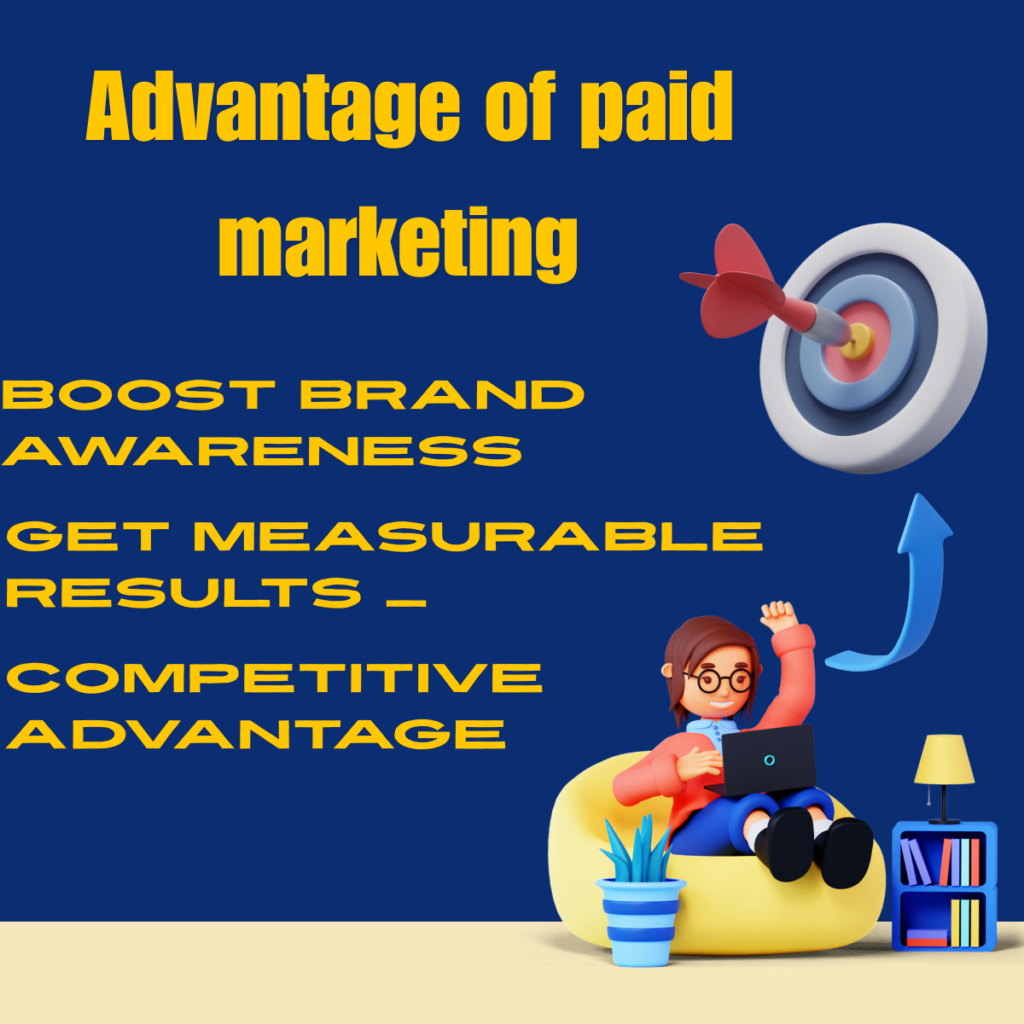
Advantage of paid marketing
Instant & Faster Results _ A major benefit of paid marketing is that it generates instant and faster results, proving highly effective in directly reaching and engaging your target audience with your product or service. By identifying and scaling the campaigns that perform best during testing and optimization, you can utilize your budget efficiently—thereby accelerating engagement and significantly increasing conversion rates.
Boost Brand Awareness _ The most effective way to boost brand awareness is through paid advertising. This method is particularly helpful for new businesses, as they need to rapidly expand their brand presence during the initial stages. Through paid campaigns, brands repeatedly display their message to their target audience—based on factors such as age group, interests, location, or behavior—thereby significantly increasing both visibility and awareness.
Get Measurable Results _ A key advantage of paid marketing is measurable results. It allows you to track campaign metrics—such as impressions, clicks, leads, and sales—thereby simplifying data-driven decision-making and enabling you to strengthen future campaigns. By adopting this measurable approach, you can calculate your ROI and introduce greater flexibility into your marketing efforts.
Achieve Maximize ROI _ Another significant advantage of paid marketing is its substantial contribution to generating maximum ROI (Return on Investment). It allows you to utilize your budget within paid campaigns in a smart and strategic manner to achieve the best possible results. Furthermore, by optimizing your campaigns, you can enhance profitability, reach the right audience, improve the quality of leads, and boost sales.
Launch anytime Targeted Campaigns _ With paid marketing, you can launch targeted campaigns at any time, thereby enabling your business to benefit from flexibility and rapid decision-making. The primary objective of targeted campaigns is to reach the right audience—based on their interests, behavior, demographics, and location—with relevant advertisements; this allows you to enhance both engagement and conversions, while also enabling you to track the performance of your campaigns.
competitive advantage _ Paid marketing provides modern-day businesses with a competitive advantage. In this process, your products and services reach the audience ahead of your competitors. A crucial factor here is “top placement,” which secures prime positions—a significant advantage, as audiences tend to prefer top-tier brands when faced with multiple options.
How to use paid marketing
To utilize paid marketing strategically, the step-by-step guidance provided below will help ensure the success of your paid advertising campaign journey.
STEP 1: First and foremost, it is crucial to establish a primary objective or goal. This lays a strong foundation and ensures you move in the right direction. Common types of goals include increasing website traffic, generating leads, increasing brand visibility, etc.
- STEP 2: Selecting the right target audience is essential for running paid ads smoothly, as this directly impacts your Return on Investment (ROI). You can define your audience based on criteria such as age group, location, gender, interests, and behavioral patterns.
- STEP 3: Choosing the advertising platform that best aligns with your target audience is a smart strategic move, as it prevents the wastage of both time and budget.
- STEP 4: Establishing a budget is mandatory for running a paid advertising campaign, as proper budgeting is the key to achieving maximum ROI.
- STEP 5: Incorporate various creative elements into your ads—such as eye-catching headlines, clear messaging, attractive images or videos, a strong Call-to-Action (CTA), and highlighted benefits—to ensure your advertisements are both appealing and engaging.
- STEP 6: Once the ad design is complete, launch your campaign. Subsequently, monitor and track key metrics—such as clicks, impressions, conversions, and cost per result—on a regular basis.
STEP 7: The final step involves optimization. This entails refining the campaign to further enhance its best-performing results, and identifying and resolving issues related to any underperforming metrics.
How to Measure Paid Marketing Results
Track ROI : Tracking the ROI (Return on Investment) of any campaign is a key metric used to measure its profitability or loss; its primary advantage is that it enables smart budgeting by helping to avoid unnecessary spending.
Conversion Rate : The conversion rate is a powerful metric whose primary objective is to track specific actions or activities—such as purchases, sign-ups, downloads, inquiries, or form submissions. The advantage of tracking conversions is that it enables you to identify issues and subsequently address them.
Cost Per Click : Cost Per Click consists of key metrics that provide better control over campaign budgeting. Its primary objective is to measure the cost incurred to generate clicks through advertisements.
Impressions & Reach : Impressions and Reach are game-changing metrics that play a pivotal role in enhancing a brand’s visibility and awareness. The primary objective of Impressions is to ensure that content appears on screens as many times as possible, while the main objective of Reach is to connect with the maximum number of new users. By tracking Impressions and Reach, you can effectively improve performance.
Engagement Rate : is a crucial metric used to track user actions on content—such as likes, comments, shares, clicks, and saves. This metric is highly instrumental in optimizing campaigns to enhance performance and serves to strengthen a brand’s identity.
The final summary
In 2026, paid marketing strategies serve as an excellent method for rapidly scaling your business. By utilizing paid advertisements to promote products and services, businesses can achieve instant visibility, targeted reach, and measurable results.
This approach employs various paid ad formats, such as search ads, display ads, social media campaigns, influencer collaborations, and more.
This blog post outlines the best paid marketing strategies, provides a step-by-step guide on their implementation, and explains the advantages and key metrics used to track results.