
B2B means Business-to-Business. In today’s world, building a successful B2B business requires thinking beyond traditional marketing. Strategies like content marketing, account-based marketing, LinkedIn authority building, and performance campaigns create a powerful B2B ecosystem. This blog explains 10 high-impact B2B marketing strategy that are proven real-world approaches, helping businesses achieve scalability, stability, and sustainable growth.
Table of Contents
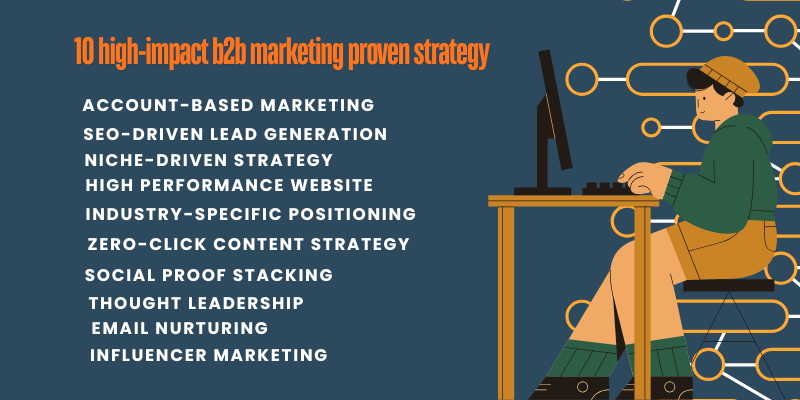
10 high-impact b2b marketing strategy
- Account-Based Marketing : Account-Based Marketing (ABM) is a smart B2B marketing strategy that focuses on high-value accounts instead of targeting a mass audience, to target businesses with actual buying potential. This process involves identifying the ideal customer profile (ICP) and specific companies, understanding their pain points, goals, and challenges, and then designing personalized content, ads, emails, and demos for them.
- SEO-Driven Lead Generation : SEO-driven lead generation is a unique strategic approach that uses search engine optimization techniques such as fast websites, mobile-friendly pages, internal linking, and proper headings to attract high-intent prospects. This strategy involves researching the right keywords that represent the buyer’s decision stage, converting actions into results, and ultimately achieving quality leads, sales, and engagement for long-term business growth.
- Niche-driven Strategy : A niche-driven strategy moves businesses away from price wars and towards value-based competition, especially when adopting a B2B marketing strategy approach. This involves choosing a specific niche such as manufacturing, healthcare, SaaS, or logistics, and designing messaging, offers, and solutions around the customer’s pain points. Using niche-specific language triggers trust and faster decision-making, and together these build authority and credibility.
- A High Performance Website : In B2B marketing, a website acts like a 24/7 sales executive. A high-performance website directly impacts leads and revenue, providing a smooth experience on both mobile and desktop devices. Instead of confusing visitors, it offers clear direction. Its simple navigation, strong calls to action (CTAs), and clean design encourage buyers to act. In terms of SEO, the website’s proper page structure, optimized content, fast loading speed, and technical strength allow search engines to easily crawl and rank it.
- Email Nurturing : Email nurturing is one of the most powerful B2B marketing strategy, whose main objective is to build long-term relationships with prospects. Value-driven, effective emails containing industry insights, use cases, tips, case studies, and solutions are delivered at the right time through personalized emails based on B2B buyer behavior to address their pain points and naturally convince them. This approach transforms the brand from a spammy seller into a trusted advisor.
- Thought Leadership – Authority that Dominates : When businesses share valuable insights, original opinions, research-based content, and future-focused ideas, they position themselves as industry experts and trusted voices in the market, which builds brand authority, trust, and credibility. This strategy triggers logic and emotion. Thought leadership content includes LinkedIn posts, white papers, reports, webinars, podcasts, and keynote-style articles, which helps reduce decision-making risk.
- Influencer Marketing (B2B Style) : In B2B influencer marketing, industry experts, consultants, founders, and thought leaders play a key role. Therefore, influence in this context stems from credibility, experience, and trust among followers. B2B influencer marketing utilizes content such as LinkedIn posts, webinars, podcasts, co-authored blogs, panel discussions, and case study collaborations. This content not only raises awareness but also generates high-quality, decision-ready leads.
- Industry-Specific Positioning : Industry-specific positioning proves to be the X-factor in B2B marketing strategy, presenting the brand as a specialist in a particular industry. Presenting website content, SEO keywords, case studies, demos, and sales pitches within the industry context makes decision-making easier. A major benefit of this strategy is that it allows you to compete in the market based on value and expertise, leading to improved conversion rates, shorter sales cycles, and better deal sizes.
- Social Proof Stacking – Doubt Killer : Social Proof Stacking is a smart and powerful B2B marketing strategy that eliminates doubts, fears, and confusion in the buyer’s mind. In this strategy, showcasing multiple proof elements such as client logos, testimonials, case studies, ratings, reviews, awards, and numbers naturally increases buyer confidence, and the buyer may even engage in word-of-mouth promotion. In social proof stacking, testimonials build emotion, and ratings satisfy logic, while the other elements play their specific roles.
- Zero-Click Content Strategy : In B2B marketing strategy, zero-click content plays a significant role for those who follow a smart digital marketing approach, focusing on delivering value directly within search results and social platforms. This is because users expect quick answers in today’s fast-paced environment. Zero-click content works for both SEO and branding. Structured content, short definitions, bullet points, and concise insights are favored by search engines and professionals alike, automatically increasing visibility, authority, and brand recall.
difference between B2C and B2B marketing strategy?
| TYPES | B 2 B | B 2 C |
| target audience & decision maker | In B2B (business-to-business), only one business trades with another business, and managers, CEOs, and finance departments play a crucial role in decision-making. | In B2C (business-to-consumer), businesses trade directly with customers, and there is typically only a single buyer. |
| Logic & Buying Process | The B2B process is long and quite complex because purchasing is based on ROI (return on investment). | The B2C process, on the other hand, is short and simple, with purchasing driven by emotions and desires. |
| Content Tone & relationship building | B2B content is professional and informative, therefore it focuses on long-term relationships. | B2C content is fun and emotional, which generates impact quickly. |
| Marketing & sales | In B2B, marketing and sales are conducted through channels like LinkedIn, email, and webinars. The impact takes longer to be seen (weeks or months). | In B2C, marketing and sales are driven through channels like Instagram, Facebook, and YouTube, and the impact is visible much faster (within days or hours). |
| Goal & customer value | The goal of B2B is lead generation and conversion, with low volume and high value. | The goal of B2C is brand awareness and sales, while it involves low value and high volume. |
scope of b2b marketing
High-Value Deals & Long-Term Clients — In B2B marketing, high-value deals and long-term clients represent one of the most attractive and powerful aspects, where products or services are utilized in the form of strategic partnerships. In high-value deals, marketers promote and sell solutions tailored to the client’s needs, which requires a premium, skill-based approach. This approach leads to long-term client stability and promotes lasting working relationships.
Career Opportunities — B2B marketing creates multiple high-potential career opportunities. As the IT, SaaS, manufacturing, healthcare, logistics, and finance industries continue to grow, the demand for B2B marketing professionals is rapidly increasing. Among the most common career opportunities is the B2B Digital Marketer, who handles SEO, LinkedIn ads, email campaigns, and lead funnels. Other opportunities include Lead Generation Specialists and B2B Content Strategists who create high-quality content to generate more leads. Many other opportunities also exist.
Global Market Exposure — In the digital era, global market exposure is one of the major advantages. Global exposure means working with international clients, on cross-border campaigns, and multi-market strategies, where brands trade their products with clients at an international level, such as those in the US, UK, Europe, the Middle East, and APAC markets. The biggest benefit of this is securing high-value projects with better payouts. This improves income potential and professional confidence.
AI, Automation & CRM Integration — For modern B2B businesses, AI, automation, and CRM integration have become smart and effective tools. AI tools analyze buyer behavior and collect customer data, allowing marketers to make accurate decisions instead of relying on guesswork. Automation facilitates smooth email nurturing, follow-ups, lead scoring, and campaign scheduling, while CRM tracks the complete customer activity journey, including initial interactions, behavior, and impressions.
Freelancing, Consulting & Agency Scope — Freelancing, consulting, and agency work offer a very wide and profitable scope. The biggest advantage of this field is that it creates stable and scalable income through long-term clients and high-ticket services. Freelancing services include lead generation, LinkedIn outreach, SEO, and content marketing. Consulting involves guiding clients on strategy, funnel design, ABM planning, and growth roadmaps, while agencies manage campaigns for multiple B2B clients, build sales pipelines, and provide end-to-end marketing solutions.
Conclusion–
B2B marketing strategy have become a fast-growing system in the modern business environment. Successful B2B businesses are those that sell with solutions, trust, and long-term value, because buyers also make decisions based on logic, ROI, risk reduction, and long-term growth. Some popular B2B marketing strategy include Account-Based Marketing and SEO-driven lead generation, which build brand credibility and scalability. This article explains the scope, types, campaign creation, definitions, and high-impact strategies in detail.
FQAs
What is B2B marketing strategy with examples?
In the B2B marketing strategy process, a company sells its products and services to other companies, organizations, or professionals. The main focus is on logic, value, and building long-term relationships to establish brand authority and become an industry expert. B2B businesses promote their products and services through channels such as LinkedIn, email, content marketing, webinars, and case studies.
Example: Adobe is a software company that provides a complete ecosystem of digital creativity and marketing solutions, targeting enterprises, agencies, media houses, and corporate marketing teams with education-based content as its core concept.
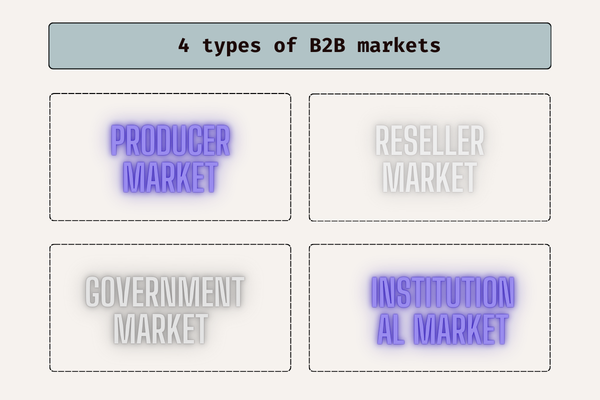
The 4 types of B2B markets
Producer Market :- The producer market is a B2B marketing segment focused on revenue generation, where new products are created using raw materials, components, machinery, or services. Manufacturing companies, factories, and software development firms are part of the producer market. Its main focus is on quality, cost-efficiency, consistency, and long-term supply.
Reseller Market :- The reseller market is a growth accelerator for the B2B ecosystem, where brands buy products or services in bulk and resell them to other suppliers without adding any creative value. This market acts as an intermediary or broker between manufacturers and customers. It includes wholesalers, distributors, dealers, agents, and B2B e-commerce platforms.
Government Market :- The government market is a stable, scalable, and trust-based segment of the B2B market where products and services are traded between central, state, and local government departments. This market is highly significant due to its role in public welfare, infrastructure development, and national growth. It includes organizations such as defense organizations, railways, municipalities, and smart city authorities.
Institutional Market :- The institutional market is a service-driven market that includes only service provider businesses such as schools, colleges, universities, hospitals, charitable trusts, and NGOs. These organizations purchase books, furniture, medical equipment, uniforms, food supplies, and software systems in bulk, and their buying behavior is quite budget-sensitive and need-based.
Importance of b2b marketing strategy essay
In today’s modern business environment, B2B marketing strategy has become a long-term growth engine, playing a crucial role in targeting the right audience and generating quality leads. Multiple stakeholders are involved in its decision-making process because a well-planned B2B marketing strategy provides businesses with clarity, consistency, and credibility, while also building trust and authority. Through content marketing, case studies, and thought leadership, brands establish themselves as experts in their industry.
What are B2B marketing strategy principles?
Strong Brand Credibility__ Strong brand credibility is a survival tool for brands that shortens the sales cycle. Because trust is already established, buyers trust the brand, making negotiations easier and leading to the development of long-term partnerships.
Educational lead approaches__ Educational Lead Approaches is a smart and trust-building strategy for brands, allowing them to be perceived as expert and reliable guides in the market. This involves sharing valuable knowledge step-by-step through content. This approach generates high-quality leads.
Decision-Maker Focus__ A critical principle for decision-makers is that ROI, scalability, risk reduction, and long-term growth are more important than price. This approach involves aligning marketing communication with their business goals, and it allows for the design of customized messaging for clients.
Multi-Channel Presence__ A multi-channel presence helps businesses build a strong foundation because buyers observe and compare brands across multiple channels before making a decision. These channels include building authority on LinkedIn, nurturing leads through email, showcasing website credibility, and providing in-depth education through webinars.
How to create a B2B marketing strategy campaign step-by-step
Step 1: Define ideal Audience & Goal– Before creating a B2B marketing campaign, you need to clearly define which business you want to target and why, and identify your ideal audience. This is because B2B buyers usually make decisions based on logic, ROI, and long-term value, rather than emotions. Therefore, it’s crucial to have a deep understanding of cost reduction, efficiency, lead generation, or automation.
Step 2: Craft a Strong Value Proposition– Crafting a strong value proposition is a crucial step in a B2B marketing campaign. This means clearly communicating the value of your product or service to the B2B buyer and explaining why it’s essential for them. A value proposition always starts with understanding the customer’s problems, deeply analyzing their pain points, and then presenting clear benefits, practical solutions, and measurable results. It demonstrates the tangible benefits the business will receive.
Step 3: Choose the Right B2B Channels– This step determines whether your message is reaching the right people, at the right time, and on the right platform. Therefore, choosing the right marketing channels and platforms is crucial. Focusing on the best channels, such as LinkedIn, email marketing, content marketing, and SEO, is the best option. This makes your marketing campaign cost-effective, targeted, and high-conversion driven.
Step 4: Execute, Track & Optimize– The final step in a B2B marketing campaign involves executing, tracking, and optimizing with discipline and consistency. During execution, ads, emails, landing pages, content, and CTAs must all be aligned with the same value proposition and goal. Tracking requires regularly monitoring metrics and ensuring that leads are sales-ready. Optimization involves improving the campaign based on the insights gained from tracking.