
A sound marketing process is an important pillar for businesses to achieve their goals and experience rapid growth. In this era, every business has made the marketing process an integral part of its operations. This marketing process has been detailed for maximum value.
Table of Contents
What exactly is the Marketing Process?
The marketing process is a structured journey that begins with market research. In the first step, customer needs, problems, preferences, and behavior are analyzed through surveys and social media insights to accurately implement the marketing strategy and planning, and to monitor and control sales, leads, engagement, and ROI. Overall, in the marketing process, a business understands its customers, creates value for them, and then effectively delivers that value, resulting in customer satisfaction and the achievement of long-term goals.
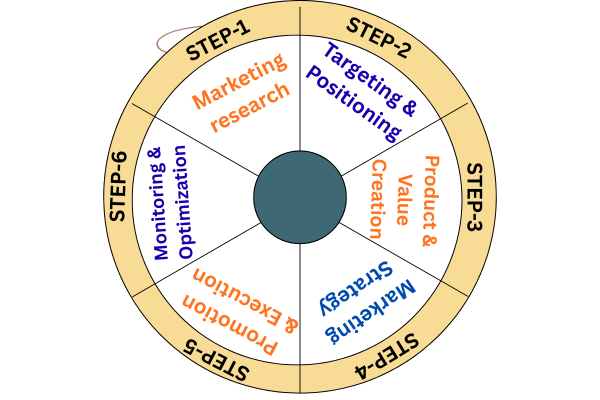
6 essential steps for marketing process with examples
1. Marketing research– The marketing process begins with market research. This involves deeply understanding customer needs, wants, behavior, and buying habits so that the right products and services can be delivered to them. Businesses gather information about market trends, customer demand, and competitors through surveys, questionnaires, interviews, and online reviews to clarify and simplify the marketing process. Market research helps businesses reduce risk, increase customer satisfaction, and increase profits.
Example: Food delivery companies first understood the needs, problems, and requirements of their customers, then selected working professionals and students as their target audience, and gradually improved their service to save them time and provide fast food delivery.
2.Targeting & Positioning– Targeting and positioning also play a crucial role in the marketing process because choosing the right customer and creating a clear brand image in their minds is essential. In targeting, businesses select their ideal audience based on their age, income, location, lifestyle, and interests. Then, in positioning, they strengthen their brand by offering products and services at affordable prices, with good quality, and providing a better customer experience.
Example: Nike is a brand that targets young athletes, fitness lovers, and sports enthusiasts. Their advertisements feature energetic people, highlighting sports performance and motivation to increase sales and revenue.
3.Product & Value Creation– For businesses, the first priority is to provide quality products and services and create real value for the customer. This builds strong brand values and trust, ensuring long-term business growth. Value creation means transforming resources into useful goods or services so that customers receive greater benefits at a lower cost, and their problems are solved.
Example: Xiaomi is a smartphone company based in China that designs its products’ features, quality, packaging, and usability while keeping customer needs, wants, and expectations in mind, and also adds extra benefits to create value.
4. Marketing Strategy– Businesses use marketing strategy to effectively deliver their products or services to the right customers. Product, Price, Place, and Promotion are considered important pillars of this strategy. Businesses also take into account market research, targeting, and positioning. A strong and clear marketing strategy helps brands survive and grow in a competitive market.
Example:Patanjali is a popular Ayurvedic company in India that manufactures health-related products. They designed their marketing strategy around the “Swadeshi and Ayurvedic” concept, attracting a large Indian audience through their promotions. They also incorporated emotional elements in their advertisements, making customers feel a personal connection with the brand.
5. Promotion & Execution– In the marketing process, simply promoting a product or service is not enough. Its execution must also be flawless for brands to be effective in the market. Marketing tools such as advertising, social media marketing, influencer marketing, email marketing, SEO, sales promotions, and offline activities are used for promotion. The main purpose of these tools is to ensure that the customer receives the right message about the product or service at the right time and that the product or service is easily available.
Example: Beauty brands and fashion accessories heavily promote their products during the festive season through Instagram ads, influencer reels, push notifications, and email campaigns because this is when customers shop and are attracted to exclusive offers and discounts.
6. Monitoring & Optimization– In simple terms, monitoring and optimization help determine the results of marketing efforts. Monitoring involves regularly tracking performance, including website traffic, ad clicks, conversions, sales, engagement, leads, and ROI (Return on Investment), using analytics and social media insights. Optimization involves measuring the results of these processes to strengthen the strategies that are working.
Example: If email marketing is generating more sales for the business, then they can further optimize the email subject lines and offers. If Instagram ads are generating revenue, they can improve those as well. There are other activities where better results are being produced, and those can be strengthened further.
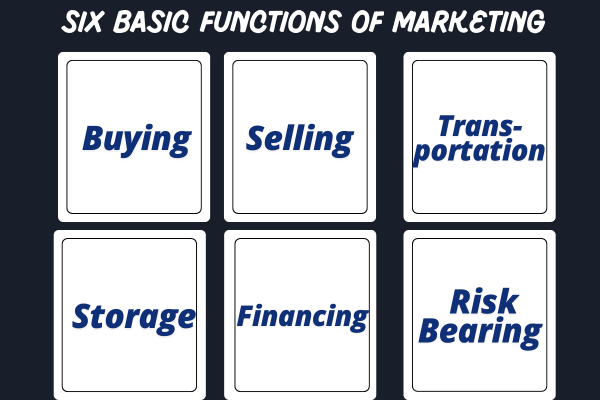
six basic functions of marketing?
1. Buying– Buying is one of the core concepts of marketing. This process involves purchasing raw materials in the right quantity, quality, and at the right price. A strong buying process ensures other marketing functions run smoothly. Buying is not limited to manufacturing companies; retailers, wholesalers, and online platforms also perform the buying function.
2. Selling– In modern marketing, the role of selling has become even more advanced because it effectively presents the features, benefits, and value of a product or service. The main purpose of selling is to understand the customer’s needs and offer solutions accordingly, leading to customer satisfaction. This promotes trust, transparency, and communication between the brand and the customer, which helps increase repeat purchases and brand loyalty.
3. Transportation– Transportation is considered one of the most crucial links in businesses, responsible for moving physical goods from the production site to consumers using different modes such as roadways, railways, airways, and waterways. Technologies like GPS tracking, route optimization, cold chain logistics, and real-time delivery updates have made transportation smarter, enabling businesses to plan and execute operations more effectively.
4. Storage– Storage is also an important part of the marketing function, whose main job is to keep products safe. Businesses use it to ensure a continuous supply. For example, retail stores, supermarkets, and e-commerce companies keep stock in their warehouses so that customers don’t find products “out of stock.” Brands like Amazon and Flipkart use large warehouses for fast delivery. Overall, storage is the backbone of marketing.
5. Financing– Financing is the most important pillar of any business because marketing activities cannot run smoothly without money, whether it’s buying, storage, transportation, or promotion. Financing is involved in every activity, such as purchasing raw materials, paying labor, packaging, warehousing, transportation, and providing credit facilities and EMI options. Therefore, arranging funds and using them properly is crucial for long-term growth in a business.
6. Risk Bearing– Risk-bearing means accepting future uncertainties and taking responsibility for the losses that may arise from them. Risks are of several types, such as demand risk, where there is uncertainty about whether the product will sell in the market or not. Consumer preferences can change. Price risk involves fluctuations in market prices. If prices fall, traders suffer losses. Credit risk involves giving goods on credit and the risk that payment may not be received on time.
What mistakes should be made in the marketing process?
There are some common mistakes in the marketing process that cause most businesses to collapse. While there are many such mistakes, we will cover the main ones that have a significant impact on businesses, as shown in the points below.
- ot conducting proper market research and launching a product or service without understanding the target audience is the biggest mistake. It’s crucial to understand customer needs, pain points, and behavior.
- A business’s first priority is to understand the customer’s needs and problems, not simply to offer products related to potential solutions.
- Incorrect product positioning and the failure to communicate a clear brand message to the target audience are also major factors.
- Not having a pricing strategy and completely ignoring your competitors is a huge mistake that can have a significant impact on your business.
- Focusing solely on protecting the product or service and failing to provide value to the customer is also sending the wrong signal.
- In the digital age, failing to use data and analytics and not monitoring and optimizing results is a mistake.
- Targeting the wrong audience on the wrong online or offline platform while promoting a product or service.
Five benefits of marketing process
Faster Market Adaptation_ Faster market adaptation is crucial in the marketing process because in today’s rapidly changing business environment, market trends, customer preferences, and technology are constantly evolving. This requires regular market research, tracking customer feedback, monitoring social media trends, and keeping an eye on competitor activities.
Higher ROI, Lower Risk_ In business, the goal is to promote products and services to generate a high return on investment (ROI) with low risk. In simple words, it means earning more profit than the investment and avoiding unnecessary losses.
Consistency Builds Credibility_ Consistent efforts such as maintaining the same strategy planning, messaging, tone, visuals, and values across all platforms build a unique credibility for the brand in the market. This credibility, in turn, makes the brand trustworthy, dependable, authentic, and customer-friendly.
Data-Driven Business Decisions_ With the advent of digital technology, businesses can now make data-driven decisions based on facts, numbers, and real insights, rather than guesswork. This involves collecting data from various sources such as customer behavior, website analytics, social media engagement, sales reports, and campaign performance.
Feedback That Fuels Improvement_ Customer feedback is a powerful benefit of marketing that provides businesses with direction for continuous improvement. A proper marketing process systematically collects and utilizes this feedback. Methods used to collect feedback include social media comments, online reviews, surveys, emails, and customer support interactions.

conclusion:-
Nowadays, the marketing process has become essential for all businesses, helping them to continuously improve and provide the right direction. Many factors and rules are involved in building a successful marketing process. This article defines the marketing process to provide you with maximum value. It covers its functions, benefits, and six essential steps you can follow to build your own marketing process.