
In today’s generation, marketing processes are being carried out using technical skills, and the demand for technical marketing skills is going to increase in the future because it simplifies business marketing. This entire blog is dedicated to the topic of technical marketing skills, and my aim is to provide you with as much knowledge and value as possible.
Table of Contents
What are technical marketing skills?
Definition _The practical tools needed to plan, execute, track, and optimize digital marketing campaigns are called technical marketing skills. SEO (Search Engine Optimization) is a pillar of technical marketing skills. SEO involves keyword research, on-page SEO, technical SEO, and analytics. Other skills include website management, data analytics, and marketing automation. These skills make marketers smarter, faster, and more results-oriented, and also drive business growth.
Why is the importance of technical skills?
In the digital and competitive era, the importance of technical skills has increased significantly. Students, working professionals, business owners, and people from other fields are learning technical skills based on practical knowledge to solve real-world problems. The benefits of technical skills include increased productivity and efficiency, and skills in data analysis, automation, and reporting empower people to become better decision-makers and give them a strong competitive edge.
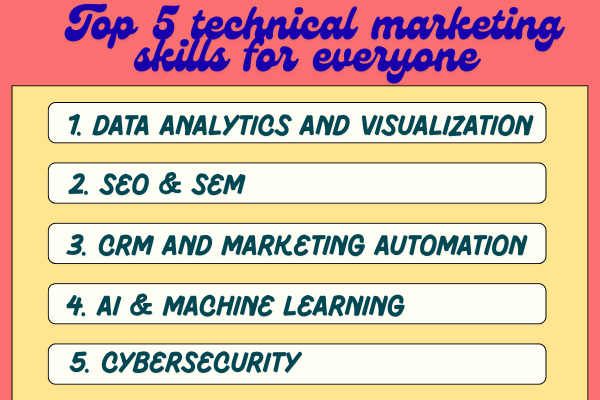
Top 5 technical marketing skills for everyone
1. Data Analytics and Visualization _ Data analytics and visualization is an effective technical marketing skill that involves collecting and deeply analyzing audience data, especially for businesses, to extract useful insights. These insights can be used to understand customer behavior, analyze sales performance, and predict future trends, leading to better decision-making. Popular tools like Excel, Power BI, Tableau, and Google Data Studio allow even non-technical users to easily analyze data.
2. SEO & SEM _ SEO and SEM are two very important pillars of digital marketing that help increase online visibility and traffic. The main purpose of SEO is to rank a website organically on search engines like Google, Yahoo, and Bing. This includes on-page, off-page, and technical SEO, which provides stable and cost-effective results for the website in the long term. SEM is a paid marketing strategy whose purpose is to generate instant visibility, traffic, leads, sales, and awareness for a brand by running online ads on platforms like Google Ads and Facebook Ads.
3. CRM and Marketing Automation _ CRM and Marketing Automation are modern technical marketing skills essential for managing marketing and sales. CRM (Customer Relationship Management) skills involve managing customer data and building strong relationships with them. It tracks customer details, interaction history, leads, follow-ups, and purchase behavior. Marketing Automation is an advanced version of CRM that saves time by automating email campaigns, lead nurturing, follow-up messages, SMS alerts, and social media scheduling. Tools include HubSpot, Zoho CRM, Salesforce, and Mailchimp.
4. AI & Machine Learning _ AI and Machine Learning make today’s businesses smarter and more efficient. Artificial Intelligence (AI) is a machine with human-like intelligence that makes decisions based on data and solves problems in smart and unique ways. Machine Learning is a part of AI whose main purpose is to provide content recommendations, product suggestions, and targeted ads based on user behavior. AI and ML also make data analysis much easier and provide 24/7 customer support. Key tools include Google AI, ChatGPT, HubSpot AI and Meta AI.
5. Cybersecurity _ Cybersecurity is a powerful and core technical marketing skill used to protect systems, networks, websites, and customer data from cyber attacks. In today’s world, the risk of threats like hacking, data breaches, phishing, malware, and ransomware has increased significantly. Online businesses store customer data, payment details, and confidential information, and a leak of this data can lead to heavy losses in brand trust and reputation, and the risk of misuse.
Why do you need technical marketing skills?
In the digital world, the demand for technical marketing skills is growing rapidly. These skills allow you to generate creative ideas, write content, build a career, ensure job security, and build businesses, among other activities. Companies prefer marketers who understand both data and technology along with creative ideas and can execute plans effectively. Some of the benefits include data-driven decision-making, automation and efficiency, SEO and performance marketing, and a better user experience (UX). Technical marketing skills make you a complete, result-oriented, and future-ready marketer.
How to improve technical marketing skills
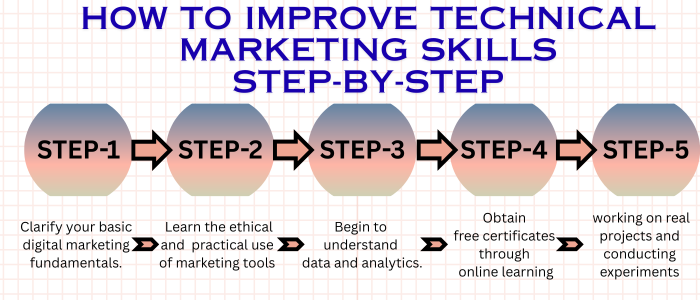
In today’s competitive environment, improving technical marketing skills has become crucial. A strong skill set can be easily developed by following a step-by-step approach. Let’s explain this through a few steps:
Step 1 – Clarify your basic digital marketing fundamentals. You should have a strong foundation in SEO, PPC, email marketing, and content marketing.
Step 2 – Learn the ethical and practical use of marketing tools such as Google Analytics, Meta Ads Manager, and email automation tools. Practice using them regularly.
Step 3 – Begin to deeply analyze and understand data and analytics. Understand metrics like CTR, CPC, conversion rate, bounce rate, and ROI in detail so that you can make smart marketing decisions based on data interpretation.
Step 4 – Obtain free certificates through online learning from popular platforms like Google, HubSpot, and Meta, or take paid courses to earn certificates that will prepare you to enter the industry.
Step 5 – After following all these steps, comes the final step. This involves working on real projects and conducting experiments, such as running blogs, websites, or dummy ad campaigns. This strengthens your continuous learning and testing abilities, allowing you to become a confident, result-oriented marketer.
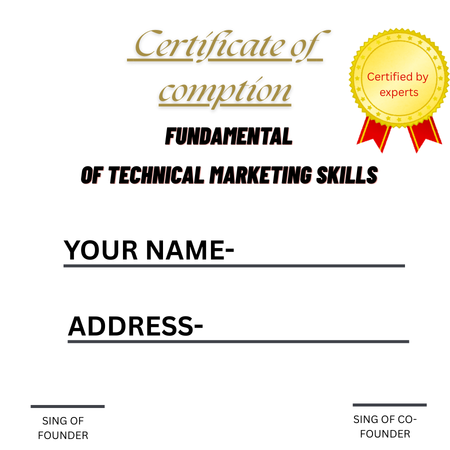
The certification you will receive after learning technical marketing skills will be similar to the image below or in a different format.
Technical skills examples
🎨 Design & Creative–Design and creative technical marketing skills are an effective example of how these skills strengthen brand identity, user experience, and marketing performance through visuals. The main tools used are Adobe Photoshop, Illustrator, and Canva, which are used to design logos, banners, posters, social media creatives, and ads. UI/UX design is also an important creative skill that creates user-friendly interfaces to ensure a smooth and engaging website or app experience.
👨💻 Programming & Development–Programming and development, when combined with technical marketing skills, are used to create software, websites, applications, and digital platforms. Programming involves languages such as HTML, CSS, and JavaScript, which form the foundation of web development. Development also utilizes languages like Python, Java, PHP, and Node.js, which manage server logic and user data. These two skill sets drive innovation and make digital solutions scalable.
💻 IT & Computer–IT and computer skills are modern-day skills that form the foundation of the workplace, as computer skills are required in almost every role, whether it’s a corporate job or a digital field. Basic skills include MS Word, MS Excel, and PowerPoint, which are used for documentation, data management, and presentations. Knowledge of operating systems like Windows, Linux, and macOS helps in system handling and troubleshooting. Email management is also an essential skill, involving professional handling of emails.
🌐 Digital Marketing–Digital marketing is one of the best examples of technical marketing skills, focusing on brand promotion, lead generation, and sales growth through online platforms. Email marketing is a crucial skill within this field, involving the creation of blogs, social media posts, videos, welcome emails, follow-up emails, and other email content designed to attract customers and connect them with the brand. Analytics and tracking are also used to measure performance.
🛠️ Industry-Specific–Industry-specific skills are those developed according to the processes, tools, and systems of a particular industry, as every company and industry has a different working style. Basic skills and industry-focused knowledge are essential for a job. For example, quality control systems and production planning tools are common in the steel industry. In the finance and accounting fields, Tally, GST software, MIS reporting, and compliance tools are used. Overall, industry-specific technical and marketing skills make professionals experts in their field.
🧾Technical Writing & Documentation–Technical writing and documentation skills are highly effective in IT, software development, manufacturing, healthcare, and corporate sectors, as they present complex information in simple, clear language. The main job of technical writers is to explain products, systems, or processes, and documentation includes creating user manuals, installation guides, training documents, and FAQs.
📱Mobile & App-Based–Almost every business targets mobile users because most users spend a significant amount of time on their mobile devices. In this approach, marketers utilize mobile and app-based technical skills for the effective management and optimization of smartphones, mobile applications, and app-centric platforms. The main focus is on helping businesses effectively reach their audience and build long-term user engagement. Additionally, knowledge of mobile payment systems and data privacy helps in developing reliable and user-safe solutions.
⚙️ Advanced Technical Skills–Advanced technical skills are effective in helping marketers progress from a professional to an expert level. These advanced skills encompass a wide range of abilities, such as Cloud Computing (AWS, Google Cloud), Data Analysis & Visualization, Database Management, and Cybersecurity practices. In addition, automation tools, AI & Machine Learning basics, and API integrations are also important components of advanced skills. These skills enable increased productivity, smarter decision-making, and ultimately, a better return on investment (ROI).
Conclusion —
In 2026, technical marketing skills will form the foundation for business success in modern marketing. It’s the best option for digital marketers, students, entrepreneurs, and professionals to ensure job security, career flexibility, and stay relevant in the fast-changing job market. Businesses use it to grow rapidly and achieve their target goals. In the future, it will empower marketers with creative thinking and technical expertise.