

Today we will discuss of the marketing fundamentals and try to understand its core concepts. Let’s start with an introduction.
Introduction:-Marketing fundamentals play a crucial role in making any startup or business successful. They also help in understanding customer needs and wants, allowing businesses to suggest relevant products and services to solve customer problems. In the digital era, marketing, through social media, mobile, and content marketing, has significantly strengthened customer engagement.
Marketing has been explained in simple words for easy understanding.
Table of Contents
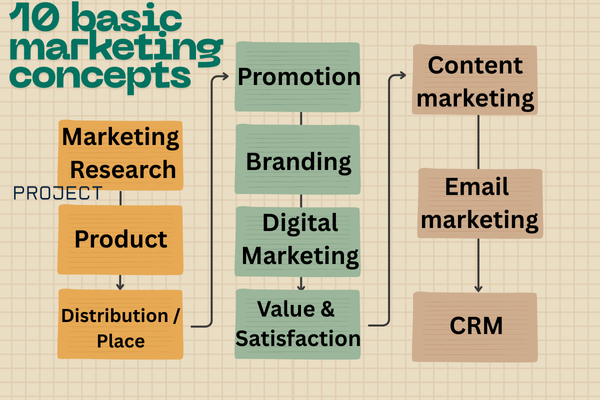
10 basic marketing concepts with examples
10 core concepts of marketing fundamentals with example
Marketing Research–Marketing research means understanding the customer’s needs, wants, and problems and then developing unique solutions through products and services. Based on data such as the behavior, preferences, buying habits, and expectations of their target audience, businesses create product design, pricing, promotion, and distribution strategies. Customer satisfaction is also paramount.
Example-Amazon provides personalized recommendations by deeply researching customer reviews, search data, and buying behavior.
Product–Products are an important part of businesses, connecting the brand and the customer. A product is not just a physical good, but also includes design, features, quality, packaging, and branding. Companies first understand customer needs and wants, then plan and develop the product. Through market research, and by maintaining product quality, efficient production, and timely delivery, they build customer trust in the brand, leading to long-term growth.
Example-The “Ghadi” detergent powder brand understood the customer’s problem and used slogans like “Try it first, then trust it” to create an emotional connection with the customers. This automatically boosted sales and revenue.
Distribution / Place–In business, choosing the right location and developing an effective online and offline distribution strategy for products and services are both crucial for success. This includes integrating e-commerce and mobile apps with physical stores. Efficient distribution improves customer satisfaction, and a strong place strategy not only expands customer reach but also helps meet their expectations.
Example-Amul, through its marketing strategy and by building a strong distribution network, has made its products easily available from cities to villages.
Promotion–Promotion plays a crucial role in establishing business in the market. Through promotion, companies provide customers with accurate information, deliver value, and understand their needs. Promotion tools include advertising, digital technology, sales promotion, social media, personal selling, and public relations. The focus is on building long-term customer relationships that automatically lead to increased sales leads and conversions.
Example-Through funny notifications and social media promotions, Zomato focuses on the needs, emotions, and satisfaction of customers of all ages, leading to long-term growth.
Branding–Businesses use branding to differentiate themselves from their competitors and establish a unique identity in the market. The branding development process takes into account customer needs, emotions, and expectations. Branding involves using a brand name, logo, tagline, packaging, and communication style to enhance the customer experience. By consistently providing a better experience, the brand becomes ingrained in the customer’s mind, leading to increased loyalty, repeat purchases, and built-up trust.
Example-Rolls-Royce represents premium innovation and quality in promoting and branding its products.
Digital Marketing–Businesses use digital marketing to reach their target audiences and create awareness about their products and services. Through digital marketing tools like Instagram, Facebook, WhatsApp, and LinkedIn, companies can easily collect customer data such as website visits, social media engagement, search behavior, and purchase patterns, and then improve their strategies accordingly.
Example-Nike enhances the customer experience through influencer marketing, digital marketing, and interactive apps, while also satisfying customers with the quality features of its products.
Value & Satisfaction–Value and customer satisfaction are powerful elements of the marketing fundamentals concept, whose purpose is to generate customer trust and attention. When businesses provide valuable products and services to customers with positive intent, customers remain engaged and satisfied with the brand. Value doesn’t just mean a low price, but rather encompasses the benefits of product quality, features, service, convenience, and the overall brand experience.
Example-Tata Motors satisfies customers with advanced and high-quality features in its cars and also provides value at budget-friendly prices.
Email marketing–According to of the marketing fundamentals, email marketing is an effective tool for direct and two-way communication with customers. Its main focus is on understanding customers’ needs and interests and then sending personalized emails to create awareness about the brand’s offers, discounts, and upcoming products and services. Doing so helps build a strong relationship with customers, develops trust, and increases repeat purchases.
Example-Ubersuggest provides its keyword research tool for free and offers its advanced features at premium pricing through email subscriptions.
Content marketing–Content marketing plays a crucial role in the fundamentals of marketing because, in today’s world, high-quality, valuable, relevant, and useful content proves effective in quickly engaging and attracting customers. Through content such as blogs, videos, infographics, and social media posts, brands educate customers, build awareness, and develop trust, which ultimately leads to sustainable business growth in the long term.
Example-HubSpot provides businesses with practical knowledge and solutions to the problems faced by their target audience through its educational blogs and guides.
Customer Relationship Management (CRM)–In the concept of marketing fundamentals, Customer Relationship Management (CRM) proves to be a key factor because CRM involves understanding customer needs, preferences, and behavior to provide a personalized experience. This increases customer trust in the brand. The company analyzes data such as customer interactions, complaints, purchase history, and feedback to provide better products, relevant offers, and timely support.
Example-OYO offers unique convenience in the hospitality sector through standardized budget rooms and an easy booking process, ensuring customers experience the best services.
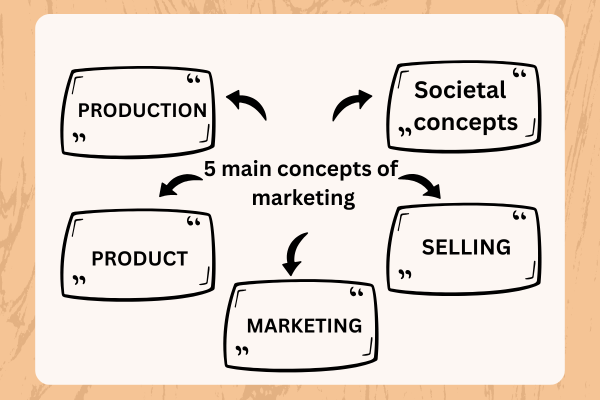
What are the 5 main concepts of marketing?
Let’s understand the 5 key pillars of marketing fundamentals that help businesses grow, through the following points.
1.Production:-Production is the main objective of any business. In this process, the company’s staff, employees, and management work together, focusing their energy on improving the production process, upgrading technology, and strengthening the distribution network. All these decisions are based on data-driven analysis of customer behavior. This ensures that customers receive products that are easily available, low-cost, and widely distributed, which in turn encourages them to make purchases.
2.Product:-In marketing concepts, product development is a vital part used in business to maintain transparency between people and brands, thereby strengthening the brand and increasing both product value and trust. In today’s competitive market, innovation and customer feedback are crucial for product improvement. A good product gives the company long-term profits and loyal customers.
3.Selling:-In the selling concept, companies primarily focus on selling techniques, advertising, personal selling, discounts, and sales promotion, rather than on the customer’s actual needs. This is because in many businesses, customers don’t naturally buy the product, so they need to be persuaded or convinced. As a result, less attention is given to customer satisfaction and long-term relationships in the selling concept.
4.Marketing:-Marketing is a concept that is essential for businesses because it helps understand customers’ needs, wants, and problems. It also gives companies information on areas where improvements are needed. Marketing focuses on long-term growth, which is why it places great importance on customer loyalty, brand trust, and repeat purchases.
5.Societal Marketing concepts:-In Societal Marketing concepts, businesses strive to balance three things: company profits, customer satisfaction, and social well-being. Under this approach, firms prioritize eco-friendly products, ethical practices, safe packaging, and sustainable production. It also emphasizes long-term trust, brand image, and social responsibility over short-term sales. Social responsibility means contributing positively to society and the environment.
What are the 4 fundamentals of marketing?
This explains the four parts of marketing fundamentals.
Product–From a marketing fundamentals perspective, businesses not only involve the exchange of products but also the provision of services. Products are physical goods that customers can touch and feel, like a Samsung smartphone. The things added to it, like the attractive design, advanced features, and other components, are all physical goods. Services, on the other hand, can only be experienced, such as hotel rooms, which offer a comfortable sleep, a clean atmosphere, and personalized service. These are examples of services.
Price–In marketing fundamentals, price is an element that the customer pays in exchange for a product or service. When deciding on a pricing strategy, companies consider factors such as cost, competition, target customers, and market demand. Pricing is also divided into basic, standard, and premium categories so that product and service features can be provided accordingly.
Place–Place marketing is an important part of marketing fundamentals that ensures the product or service reaches the right customer at the right time and in the right place. Businesses use wholesalers, retailers, and distributors in offline channels, and online platforms like Amazon, Flipkart, company websites, and mobile apps. This results in faster delivery and greater market reach for the brand.
Promotion–Promotion plays a crucial role in marketing fundamentals. Businesses use promotion to create brand awareness among their target audience through messaging. The main purpose is to inform, persuade, and remind customers about the business’s products and services. Tools such as advertising, sales promotion, personal selling, and public relations are used. In digital promotion, powerful tools like social media marketing, influencer marketing, and email marketing are utilized.
Conclusion–
In today’s era, it is crucial for businesses to understand marketing fundamentals and their core concepts. Implementing marketing fundamentals and core concepts within a business allows for faster, smoother, and more efficient growth. This article explains these elements in detail, along with examples, so that you can utilize them to generate better results.
Marketing fundamentals FQAs
What is the definition of marketing?
Marketing is an effective and powerful tool that businesses use to promote their brand and create awareness of their products and services among customers. Its main focus is on understanding customer needs and wants, creating value for them, and effectively delivering that value. Marketing fundamentals include activities such as market research, product development, pricing, promotion, distribution (place), and customer service. Businesses use marketing fundamentals to create strategies that help them achieve long-term growth.
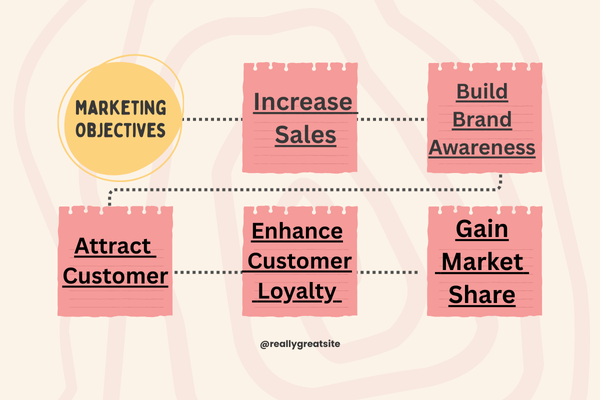
What are the Main Objectives of Marketing?
Marketing fundamentals involve many objectives, which are explained in a simplified way through the following points:
1. Creating Brand Awareness – Creating awareness among people about the brand is very important to establish a distinct identity for the brand. This helps people understand which brand the product or service belongs to and that it exists in the market.
2. Increasing Sales & Profit – When a business provides its customers with the best quality and features in its products and services, customer trust increases, leading to repeat purchases. This automatically increases sales and profits.
3. Facing Competition – Using a robust and effective marketing strategy helps businesses stand out from their competitors and remain competitive.
4. Customer Relationship Building – Building customer relationships is a main objective that plays a crucial role in the long-term growth of a business. The process is simple: solving the audience’s problems with unique products or services so that they are satisfied, thereby building trust and loyalty towards the brand.
What are the fundamentals of marketing?
Marketing fundamentals are the elements used to ensure a business runs smoothly and in the right direction. These fundamentals include customer needs, wants, and demands, relationship marketing, digital marketing, and value and satisfaction—all elements that make a business customer-focused and successful.
Difference Between Marketing and Selling?
The main focus of marketing is to understand the customer’s needs, demands, and problems and provide smart and unique solutions, thereby enhancing the brand image and building long-term customer loyalty, strong relationships, and trust. The main focus of selling, on the other hand, is simply to sell the product or service by any means necessary, even if it involves deceiving the customer.
How important is marketing in business?
Marketing fundamentals are crucial for businesses because marketing identifies customer needs and wants and connects with them emotionally and practically. The data gathered through marketing, such as customer behavior, purchase history, and interests, helps in improving marketing strategies. It also helps in increasing sales and revenue, facing competition, and building strong relationships and loyalty.
4 thoughts on “Fundamentals in marketing: A guidance of core concepts ”