
In today’s world, businesses need to develop consumer behavior marketing strategies to build strong relationships with their customers. This blog outlines seven proven strategies, along with meaningful tactics and important considerations.
Table of Contents
What is Consumer behavior marketing?
Consumer behavior marketing is a core part of business. In this process, consumer emotions, needs, preferences, habits, and decision-making are deeply analyzed to make marketing strategies more relevant, persuasive, and results-oriented. By understanding customers’ problems, wants, and desires, businesses can design ads, content, pricing, and offers that are tailored to their customers. Consumer behavior marketing strategies also involve several factors such as psychological factors, social factors, and personal factors.
Why Important Consumer behavior marketing strategy
In today’s competitive market, consumer behavior marketing has become crucial because customers have more options, leading to rapidly changing choices and expectations. This strategy involves businesses understanding their customers’ mindset so they can make their marketing efforts more accurate and effective. The benefits for brands include better targeting of the right audience, improved customer experience, and increased brand loyalty and trust. Overall, a consumer behavior marketing strategy makes businesses data-driven, customer-centric, and oriented towards long-term success.
How does it work?
1. First, customer data is collected through forms and surveys, including information such as age, location, interests, buying history, search behavior, and social media activity.
2. The collected data is analyzed to understand the customer’s needs, wants, and desires, allowing for the design of targeted ads and content.
3. Consumers are divided into different groups based on their age, income, lifestyle, and behavior, making targeting easier.
4. Personalized messages, offers, content, and ads are sent to these divided groups, specifically designed for each group.
5. Targeting customers on the right platform is crucial. Marketing efforts are focused on platforms where the customer is most active, such as Instagram, email, and Facebook, to maximize reach and engagement.
6. Customers are influenced using urgent words like “Limited Offer,” “Hurry Up,” and emotional triggers to motivate their buying decisions.
7. Finally, the campaigns are analyzed, and the strategy is improved based on the generated clicks, conversions, sales, and consumer response.
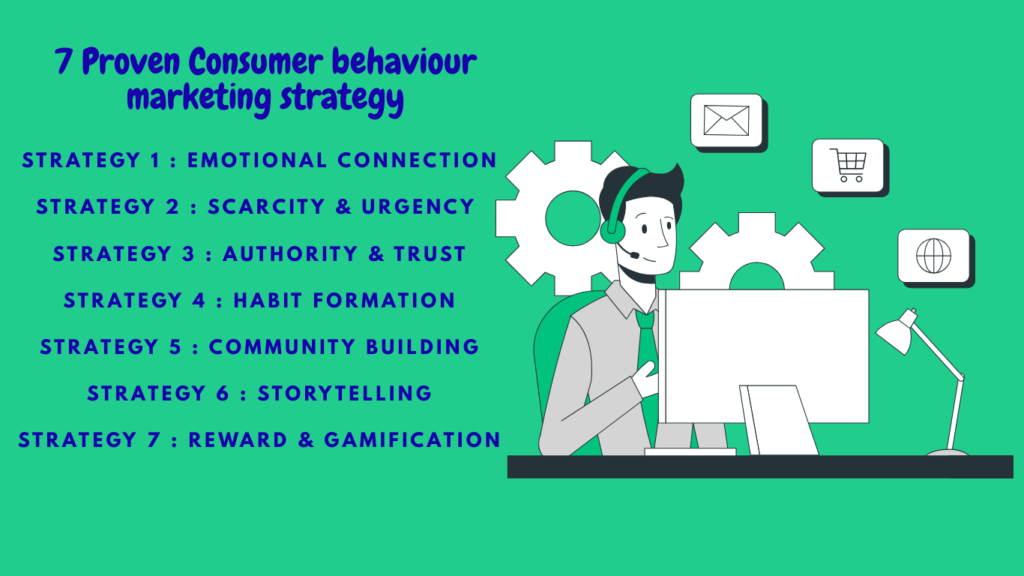
7 Proven Consumer behavior marketing strategy
Strategy 1 : Emotional Connection __ Emotional connection is one of the most powerful strategies in which a brand targets its customers’ feelings, emotions, and personal values, which builds trust and loyalty for the brand. Brands run marketing campaigns to strengthen the emotional connection with customers, making them feel that the brand understands and cares for them. Emotional ads and content are also more memorable.
Strategy 2 : Scarcity & Urgency __ Scarcity and urgency are high-conversion marketing strategies in consumer behavior that motivate consumers to make quick decisions. In this strategy, scarcity involves showing limited availability of a product or service, such as “Only 5 items left” or “Limited seats available.” Urgency involves creating time pressure, such as “Offer ends tonight” or “Last 24 hours remaining.” Both of these strategies accelerate the consumer’s decision-making process.
Strategy 3 : Authority & Trust __ Authority and trust are among the most powerful psychological triggers in consumer behavior marketing. Authority is an element that brands use to show customers that they are experts in a particular field or work with experts. Trust automatically develops when a brand delivers consistent quality, transparent communication, and honest promises. Additionally, secure payment icons, privacy policies, and clear refund terms on online platforms also act as trust signals.
Strategy 4 : Habit Formation __Habit formation is a core part of consumer behavior marketing that generates repeat actions and repeat purchases for a brand. The habit formation process usually follows three steps: Trigger, Action, and Reward. The trigger involves providing customers with notifications or reminders about the service or product. Following this, the customer takes action or performs an activity, and the reward is the result of the action the customer takes, such as satisfaction, benefit, or pleasure.
Strategy 5 : Community Building __ Community building is a strong, relationship-driven strategy in which a brand creates emotional and social connections with its customers. When a brand engages in community-building activities, it fosters a sense of belonging and loyalty, which boosts repeat purchases and brand advocacy. The main focus of community building is to connect customers around a common interest, value, or purpose. This involves the brand encouraging discussions, knowledge sharing, feedback, and mutual support.
Strategy 6 : Storytelling __Brand storytelling creates a highly effective emotional connection with customers by presenting messages in the form of stories. The human brain naturally connects with stories, which is why storytelling content is more memorable, relatable, and engaging. This strengthens the emotional bond and activates emotions such as trust and motivation.
Strategy 7 : Reward & Gamification __Brand reward and gamification methods are used to encourage consumers to take desired actions through fun, rewards, and achievements. The basic concept of gamification involves using points, badges, levels, streaks, and rewards, where the brand engages the audience with challenges and activities and provides rewards for each achievement. This motivates consumers to take the next action because nowadays, consumers expect not only discounts but also interactive and rewarding experiences.
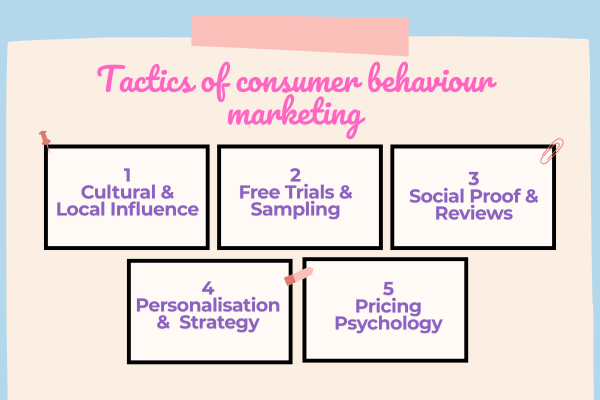
Tactics of consumer behavior marketing with examples
Cultural & Local Influence__ Cultural and Local Influence: In a diverse country like India, culture plays a crucial role in impactful marketing because festivals, rituals, food habits, dressing sense, and family values directly influence buying behavior. For example, the shopping craze automatically increases during festivals like Diwali, Holi, Eid, and Raksha Bandhan. When ads or content are in regional languages, consumers perceive the brand as more relatable and trustworthy.
Example-Cadbury India runs emotional advertisements during Diwali and Raksha Bandhan, launching special gift packs that highlight family bonding and traditional culture. This not only generates sales but also evokes emotions, which is crucial for long-term growth.
Free Trials & Sampling__ Free trials and sampling are highly effective tactics in consumer behavior marketing that brands use, especially in the offline market, to build trust. Offering free trials reduces customer fear and perceived risk, and the real experience increases buying confidence. This strategy positively influences customer behavior.
Example-Food delivery companies like Zomato, Swiggy , and Insta-mart initially offer trials or introductory benefits. If the experience is positive, users later choose a paid membership plan.
Social Proof & Reviews__ Social proof and reviews prove to be a game-changer for brands in the digital era. In today’s world, people want to see what others are saying about a brand before buying any product or service. Positive online reviews and ratings strengthen buying decisions and simultaneously build credibility, reliability, and confidence in the consumer’s mind.
Example-E-commerce businesses like Amazon, Flipkart, and Myntra display customer star ratings and written reviews along with their products to build trust among new customers and increase sales.
Personalisation Strategy__ In a personalization strategy, brands collect customer data and divide them into categories based on their preferences, interests, behavior, and past interactions. This allows them to offer relevant content and discounts, creating maximum value for the customer. This, in turn, increases engagement and builds long-term relationships.
Example-Google Maps automatically displays route suggestions, traffic alerts, and time estimates based on the user’s daily travel patterns. This personalization feature shows the user the traffic status in advance, saving them time.
Pricing Psychology__ Pricing psychology is a smart consumer behavior marketing strategy. In this process, the product’s price is made to appear more affordable, valuable, and attractive, so that customers perceive it as a worthwhile deal. This is because consumers react psychologically first, rather than logically, which is why the price is carefully designed.
Example-Businesses often price their online courses or subscriptions in basic, pro, and premium tiers, for example, Basic – 999, Pro – 1799, and Premium – 3599. Customers usually find the Pro plan most attractive because its features offer more value than the Basic plan and it feels quite affordable compared to the Premium plan.
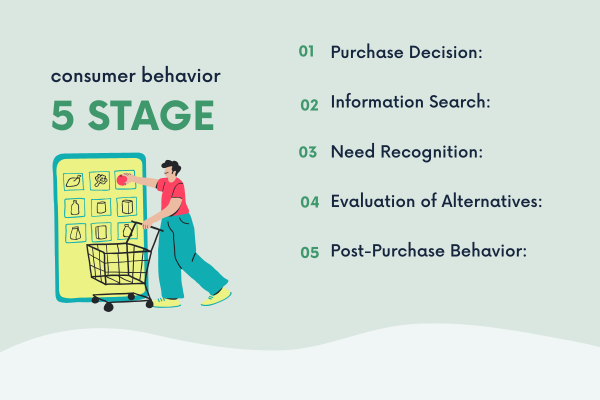
What are the 5 stages of consumer behavior?
Purchase Decision: The most important stage of consumer behavior is the purchase decision. Price, discounts, offers, and payment options all significantly affect the purchase decision. When brands offer limited-time offers or discounts, it creates a sense of urgency in the consumer’s mind, prompting them to purchase the product immediately. Additionally, product reviews and ratings also play a crucial role because people trust the experiences of others.
Information Search: Information search is used to build business awareness. It is mainly of two types: offline and online. Offline sources include recommendations from family and colleagues, while online sources include Google, YouTube, social media platforms, and website reviews. When a customer finds a brand’s content helpful, informative, and easy to understand, they consider that brand more seriously, and this is where the customer’s first impression is formed.
Need Recognition: In the Need Recognition stage, when a brand interacts with the consumer, it marks the starting point of the buying process. In this process, the customer realizes a lack or a problem. This need arises from personal experiences, such as a change in lifestyle or feeling bored with their routine. Sometimes, the need develops due to external influences. A clear understanding of the need increases the importance of marketing, allowing brands to target emotions, problems, and aspirations to highlight the need in the consumer’s mind.
Evaluation of Alternatives: Evaluation of alternatives is a core part of consumer behavior. At this stage, consumers logically and emotionally compare different brands, products, or services based on price, quality, features, reviews, and value for money. Brand comparison pages, case studies, testimonials, free trials, and clear unique selling propositions (USPs) help convince consumers to purchase a product or service.
Post-Purchase Behavior: Post-purchase behavior impacts the consumer journey in the long term. This journey determines whether the customer will remain loyal to the brand or switch to a competitor. In this process, brands solve customer problems in a unique way with their products and services, satisfying them so that they make repeat purchases. Several other factors also influence consumer behavior, such as thank-you emails, feedback forms, loyalty programs, and support calls, which make the customer feel valued.
Conclusion:-
In today’s competitive and fast-changing market, consumer behavior marketing has become extremely important for businesses to stay ahead of the competition. To achieve long-term success, brands deeply understand customers’ emotions, needs, habits, and decision-making processes and develop strategies accordingly. The consumer journey spans several stages, from need recognition to post-purchase. Overall, consumer behavior marketing makes businesses customer-centric, data-driven, and relationship-focused.
1 thought on “7 Proven Consumer behavior marketing strategy: meaningful, tactics, important ”